
Lacan s Clinical Technique Lack nian Analysis Antonio Quinet
Lacan’s Clinical Technique Lack (a)nian Analysis by Antonio Quinet (z-lib.org)
The main treat-ment guideline is getting the analysand to speak and plunge into free association
such as tentative treatment (preliminary interviews), use of the couch, and the handling of time and money
Accordingly, Lacan lays down a transfer-ence strategy as semblant and interpretation tactics as poetical
Analysts need not be dogmatic sticklers to Freud’s framework. But they must know the “whys and wherefores” of their technical approach and also surrender themselves to the same structure of analytical procedures.
They may, however, guide treatment to unravel the threads of alien-ation signif i ers and help patients recognise the lack behind desire that no signif i ers can cover or disguise
they themselves too have undergone analysis and reached their own lack point.
desire”. This “desire” is the Lacanian ethical operator that guides all the analyst’s acts and steers the treatment.
That seminal text is a precious record of Freud’s desire to analyse himself: a stunning por-trait of self-discovery and self-knowledge in which the young analyst learns that the true interpreter of dreams is himself
It is a desire knotted in sexuality and signif i ed in the child’s earliest representations. It is desire running wildly after signif i ers and images to represent, construct, depict, and stage itself.
Whereas this ineffable enigma is not a pure Real and does not have, nor can have, signif i ers to label it, but it can indeed get the analysand’s symbolic juices fl owing.
The analyst’s desire is signposted by assertiveness, open acceptance of the overf l owing and plentiful void rather than negativity, denial or need for fulf i lment: it is the desire, says Lacan, to obtain the pure difference
the analyst will shy away from any little club or group representing the vested inter-ests of some S1 agents playing the Master or their peers and friendly competitors.
The analytical act and the analyst’s desire are strictly enmeshed with each other. They are the fi nal aim and the highest aspiration of analysis.
The act also starts analysis
An individual sets up an appointment with an analyst to start treat-ment: the how, when, and why of the session will all depend on the ana-lyst’s personal decision
The psychoanalytic act par excellence is the one in which the analysand becomes the analyst.
the analyst is now able to deal with the semblant of the object causing desire for the analysand
the analyst is only authorized by himself
And similar to hysterics, neu-rotics prefer complaining to acting or striking while the iron is is hot
???????????????????????????????????????????????????????????????
during his or her analysis;
The awareness of the lack and incompleteness inherent to jouissance is particularly important since it is a key factor involved in pinpoint-ing the impossibility of having all we want, of complete knowledge
or full satisfaction or fi nding that perfect harmony in a relationship with another person. In Lacanian terms, a sexual “relationship” is non-existent.
So, analysts only fi nd the reason for the analytical act itself at the end of their own analysis
The MD and the UD are the discourses of domination; the former through rule over subjects, the latter through knowledge
The HD agent is the subject of the unconscious (S) and the AD agent is object a (object-cause-of-desire and surplus jouissance). The latter two discourses go against the grain of the MD and UD
Therein, he resorts to Freudian concepts such as Repetition, Death Drive, Beyond the Pleasure Principle, and the superego which he equates with object a.
The fi eld of jouissance is, primarily, a linguistically structured con-ceptual and operational fi eld.
Grammar gives way to drama, melodrama, and chaos.
but that which causes desire forever remains
If psychoanalysis is the reverse of civilisation, Lacan enters psychoanaly-sis through the back door of civilisation.
you, who are overthrowing your professors, you who are rising up against your educators, you know what you want? A new Master.
The fact is that, in all truth, it (wordless discourse) is able to subsist without words. It subsists in certain fundamental relations. The lat-ter literally would not be able to be maintained without language.
(Lacan, 1969–1970, p. 11.
Lacan here is speaking of “speech-less” structures that are never-theless not “language-less
language no longer just deals with speech but also with silence and acts.
Something primordial (a kind of a priori silent “statement”) thus remains concealed yet somehow conveyed in language; something undef i nable that manifests itself beyond words in social relationships and actions.
Something “in the air” so to speak, like a screaming silence, which may express itself by a wordless act
Look, but don’t touch.
Touch, but don’t taste. Taste, but don’t swallow
AD is most certainly not that of the discourse of the unconscious, but rather the very opposite.
the AD aims at freeing subjects from this signifying alien-ation
it is precisely what civilisation casts aside which dominates the AD. That’s why the MD, as the social bond instituted by civilisation, is precisely “the reverse of psychoanalysis
The analyst cannot be the one who knows and teaches analysands something they do not know about the unconscious because he or she actually does not know.
Through free association, using the analysand’s utterances and speech, analysts push analysands to become their own analysts.
The place and role of the analyst is to represent object a as the analysand’s cause of desire. That means analysts are not tied in a social bond as an ordinary people with their egos and Imaginary registers (conscious, meaning, imagination, etc.) nor as subjects with their own desires, life stories, and feelings.
To do so would risk treating analysands as objects to satisfy their fantasy.
But what do they know? Certainly not bookish knowledge that ref l ects the analyst’s culture. Rather, knowledge about the structure of the unconscious, about castration and the lack analysts discover and become aware of during their own analysis and training.
It is a unique form of knowledge whose awareness grows with each new discovery:
it is the very knowledge about lack and about the impossibility of any absolute knowledge.
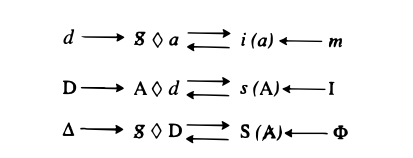
Transference love is conveyed in the three registers:
?????????????????????? (a–a’) is related to the analyst’s personhood through the narcissistic construction of his or her body, manners, dress, appearance, off i ce, personality, etc.
????????????????????? is related to signif i ers the analysand “picks up” in analysts and their environment relocated to the Other’s locus. The signif i ers are related to the ego ideal, or in Lacanian parlance, the Ideal of the Other .IA.
????????????????? is represented by object a, their analysands chance upon during a fortuitous encounter with someone they choose as their analyst. Lacan discovered this to be the quintessence of trans-ference through the agalma or precious object. When real transference takes place, patients feel their analyst is a kind of godsend.
claims to understand “.…. nothing beyond the subject of Eros” becomes Lacan’s central text on transference.
there is no overlapping between what one lacks and what the other has.
Freud describes the necessary conditions or prerequisites for treatment that analysts must deal with:
the experimental or trial period before signing the patient on, length of sessions/treatment, fees and use of the couch, which are all integral parts of the analytical technique
He is to tell us not only what he can say intentionally and willingly, what will give him relief like a confession, but everything else as well that his self-observation yields him, everything that comes into his head, even if it is disagreeable for him to say it, even if it seems to him unimportant or actually nonsensical.
It is free association that signals the dawn of psychoanalysis and also the start of all analysis: it is only there that analysis must necessarily begin.
Freud’s single rule of thumb deals with free free-f l oating attention on the part of analysts, namely, that they focus not so much on the sense of the words being uttered from the patients but on the equivocal linguistic twists or unconscious wordplay that spontaneously arise.
Lacan’s demand for the need of preliminary interviews before accepting a patient for analy-sis, and in this time establishing diagnosis, symptom, and transference functions. These interviews match what Freud called the experimental or trial period of analysis.
time and money are dissociated and need not heed the logic of the capitalist catchphrase “time is money”.
If not by artif i cially turning Freud’s prerequisites into statutes, then what makes a psychoanalyst qualif i ed? Kafka’s “Lacanian” aphorism gives us the answer: “Beyond a certain point, there is no return, this point has to be reached”
the analyst’s fi rst goal is to attract patients to treatment rather than to the analyst as a person.
it will be their personal decision to accept or decline the patient’s demand for analysis.
Lacan reminds us there is only one true demand which leads to the start of analysis—the demand to rid oneself of a symptom.
What is at stake during the preliminary interviews is not the subject’s analysability or his or her strong or weak ego to undergo the hardships of the analytical process. Analysability is a function of the symptom not the subject.
by transforming the subject’s complaint into an analytical symptom.
Hysteria is the unconscious at work.
One denies and simultaneously retains it—the neurotic’s repression (Verdrängung) that refuses the repressed element but tucks it away in the unconscious—and the perverse denial (Verleugung) that denies the element but holds on to it as a fetish. Finally, the psychotic’s forclusion (Verwerfung) is also a form of denial which leaves no trace or residue: it wipes out and erases the element
Whereas doubts are a feature of the neurotic because they evince the split subject caught between a “yes or no”, in psychosis, unbending certainty is already a sign of disruption
in language.
Lacan who says there is no subject that can be cured, for nobody can be cured of the unconscious (Lacan, 1984, p. 18). No matter how much analysis neurotic subjects undergo—even crossing beyond their fantasy and reaching the terminus of analysis—the unconscious will never cease to manifest itself, because its divisions appear in the subject’s slips of the tongue, dreams and jokes: our own subjectivity has no cure This holds true for “neurotics”, “psychotics” and all subjects:
we are all incurable.
Since analysts are called upon to occupy the place of the subject’s Other to whom his or her demands are addressed, it is important dur-ing preliminary interviews to have a clear idea of the kind of relation-ship the subject has with the Other.
The analyst’s function is knowing how to deal with it and use it during analysis. Transference proceeds from the analysand but it is the analyst who manoeuvres it.
psychoanalysis is born anew and tailor-made to fi t the needs of each new patient
Consequently, the analyst is able to reveal the essence of desire and show how it appears as the Other’s desire
enacting the sexual reality of the unconscious.
Pointing the patient to the couch signals the end of the preliminary interviews and the start of analysis proper.
the couch allows the analysand to relax and sets the analyst at ease from being stared at.
forcing patients to lie down where they might feel uncomfortable with the analyst gazing at the back of their necks.
the use of the couch has, above all, a historical signif i cance for Freud: it is the leftover from the era of hyp-nosis.
Lying down on the couch is a favourable condition for isolat-ing transference in signif i ers and assailing the narcissistic wall
- Time in psychoanalysis must correspond to the structure of the Freudian fi eld. This is thus not merely a technical or empirical issue, because time matches the core concepts of psychoanalysis.
- The logic of the unconscious and ethics rather than bureaucratic planning determine the length of psychoanalytical sessions.
- The logic of psychoanalytical sessions without a pre-set time is grounded on two distinct def i nitions of structure that take into account two aspects of the subject.
- Time in analysis opposes the neurotic’s sense of time.
- Session time must entail the end of analysis. Therefore, the end of the analysis is always implicit in that time
What does time mean in analysis? How long should a session or treatment last? “Walk.” is Freud’s answer
Lacanian analysands must fi nd the answers to their questions on their own.
ana-lysts should allow the analysand’s words to guide them during analy-sis, which is essentially a speaking experience in the fi eld of language.
The analyst brings out the uncon-scious by punctuating the analysand’s speech.
It is the break or pause in the plot of the analysand’s storytelling rather than chronological time that ends a session.
the neurotic’s diff i culty for action: it is always too late or the time is not right.
For neurotics, the time issue can be associated with the structure of their desire, since the latter is always hindered by its own impasse:
unsatisf i ed desire, in the case of hysteria, and impossible desire in the case of obsessional neurosis. Hysterics always anticipate everything, arrive too early and miss the point while obsessional neurotics post-pone everything and wind up arriving too late
For neurotics, the hour of their desire’s “moment of truth” never arrives: they fi nd a way out, escape, hesitate, scurry away or procras-tinate. Neurotics are always losing track of time because they are sus-pended in the Other’s time—which is a correlate of their desire to be suspended in the Other’s desire: neurotics take their desires from the Other’s desires.
But there is never enough time or love for the neurotic.
Whereas hysterics use delays and absences to make the Other miss them, obsessional analysands ref i ne their work during analysis to closely follow the Other’s time and rise up against this Other who supposedly disrespects uniform time and whose whims and tyranny appear in the father-f i gure of jouissance
He (the analyst) can point out that money matters are treated by civilized people in the same way as sexual matters—with the same inconsistency, prudishness and hypocrisy
The fees analysts charge allows them to calculate the subject’s libido in purely monetary terms. If, on the unconscious level, what belongs to the process of ciphering tallies up with the fi gures of a business transac-tion, capitalism equates the amount and the currency sign with the total value libido at work in the subject. Is this true?
money is libido. Money circu-lates according to the laws of language.
The next point that must be decided at the beginning of treatment is the one of money, of the doctor’s fee. An analyst does not dispute that money is to be regarded, in the fi rst instance as a medium for self-preservation and for obtaining power; but he maintains that, besides this, powerful sexual factors are involved in the value set upon it.
The prostitution fantasy
If symptoms are the subject’s easiest and most immediate investment for libido capital, why set up an appointment with an analyst?
At the fi rst stage, subjects become aware that they are paying an exorbitant price for their symptom in terms of cost/benef i t. Symptoms are, in fact, commitments and formations of the unconscious. The symptom’s jouissance is paradoxical: it brings both pleasure and pain (it is the satisfaction of an impossible desire). But there comes a point when the commitment is broken and pain brings on an imbalance in libidinal economy that can lead the subject to seek out (but not always) professional help. This fi rst stage alone, however, will not suff i ce to do the trick.
A second stage becomes necessary: subjects chose to try to decipher the hang-up and assume there is indeed a ciphered meaning embedded in the symptom which is now aff l icting them. Finally, the third stage:
subjects become aware their problem is not physiological or religious but purely subjective.
Zen and the art of the analyst
—
Reading books with ReadEra
https://play.google.com/store/apps/details?id=org.readera.hl=en
Lacan’s Clinical Technique Lack(a)nian Analysis
Lacan’s Clinical Technique Lack (a)nian Analysis by Antonio Quinet (z-lib.org)
The main treat-ment guideline is getting the analysand to speak and plunge into free association
such as tentative treatment (preliminary interviews), use of the couch, and the handling of time and money
Accordingly, Lacan lays down a transfer-ence strategy as semblant and interpretation tactics as poetical
Analysts need not be dogmatic sticklers to Freud’s framework. But they must know the “whys and wherefores” of their technical approach and also surrender themselves to the same structure of analytical procedures.
They may, however, guide treatment to unravel the threads of alien-ation signif i ers and help patients recognise the lack behind desire that no signif i ers can cover or disguise
they themselves too have undergone analysis and reached their own lack point.
desire”. This “desire” is the Lacanian ethical operator that guides all the analyst’s acts and steers the treatment.
That seminal text is a precious record of Freud’s desire to analyse himself: a stunning por-trait of self-discovery and self-knowledge in which the young analyst learns that the true interpreter of dreams is himself
It is a desire knotted in sexuality and signif i ed in the child’s earliest representations. It is desire running wildly after signif i ers and images to represent, construct, depict, and stage itself.
Whereas this ineffable enigma is not a pure Real and does not have, nor can have, signif i ers to label it, but it can indeed get the analysand’s symbolic juices fl owing.
The analyst’s desire is signposted by assertiveness, open acceptance of the overf l owing and plentiful void rather than negativity, denial or need for fulf i lment: it is the desire, says Lacan, to obtain the pure difference
the analyst will shy away from any little club or group representing the vested inter-ests of some S1 agents playing the Master or their peers and friendly competitors.
The analytical act and the analyst’s desire are strictly enmeshed with each other. They are the fi nal aim and the highest aspiration of analysis.
The act also starts analysis
An individual sets up an appointment with an analyst to start treat-ment: the how, when, and why of the session will all depend on the ana-lyst’s personal decision
The psychoanalytic act par excellence is the one in which the analysand becomes the analyst.
the analyst is now able to deal with the semblant of the object causing desire for the analysand
the analyst is only authorized by himself
And similar to hysterics, neu-rotics prefer complaining to acting or striking while the iron is is hot
???????????????????????????????????????????????????????????????
during his or her analysis;
The awareness of the lack and incompleteness inherent to jouissance is particularly important since it is a key factor involved in pinpoint-ing the impossibility of having all we want, of complete knowledge
or full satisfaction or fi nding that perfect harmony in a relationship with another person. In Lacanian terms, a sexual “relationship” is non-existent.
So, analysts only fi nd the reason for the analytical act itself at the end of their own analysis
The MD and the UD are the discourses of domination; the former through rule over subjects, the latter through knowledge
The HD agent is the subject of the unconscious (S) and the AD agent is object a (object-cause-of-desire and surplus jouissance). The latter two discourses go against the grain of the MD and UD
Therein, he resorts to Freudian concepts such as Repetition, Death Drive, Beyond the Pleasure Principle, and the superego which he equates with object a.
The fi eld of jouissance is, primarily, a linguistically structured con-ceptual and operational fi eld.
Grammar gives way to drama, melodrama, and chaos.
but that which causes desire forever remains
If psychoanalysis is the reverse of civilisation, Lacan enters psychoanaly-sis through the back door of civilisation.
you, who are overthrowing your professors, you who are rising up against your educators, you know what you want? A new Master.
The fact is that, in all truth, it (wordless discourse) is able to subsist without words. It subsists in certain fundamental relations. The lat-ter literally would not be able to be maintained without language.
(Lacan, 1969–1970, p. 11.
Lacan here is speaking of “speech-less” structures that are never-theless not “language-less
language no longer just deals with speech but also with silence and acts.
Something primordial (a kind of a priori silent “statement”) thus remains concealed yet somehow conveyed in language; something undef i nable that manifests itself beyond words in social relationships and actions.
Something “in the air” so to speak, like a screaming silence, which may express itself by a wordless act
Look, but don’t touch.
Touch, but don’t taste. Taste, but don’t swallow
AD is most certainly not that of the discourse of the unconscious, but rather the very opposite.
the AD aims at freeing subjects from this signifying alien-ation
it is precisely what civilisation casts aside which dominates the AD. That’s why the MD, as the social bond instituted by civilisation, is precisely “the reverse of psychoanalysis
The analyst cannot be the one who knows and teaches analysands something they do not know about the unconscious because he or she actually does not know.
Through free association, using the analysand’s utterances and speech, analysts push analysands to become their own analysts.
The place and role of the analyst is to represent object a as the analysand’s cause of desire. That means analysts are not tied in a social bond as an ordinary people with their egos and Imaginary registers (conscious, meaning, imagination, etc.) nor as subjects with their own desires, life stories, and feelings.
To do so would risk treating analysands as objects to satisfy their fantasy.
But what do they know? Certainly not bookish knowledge that ref l ects the analyst’s culture. Rather, knowledge about the structure of the unconscious, about castration and the lack analysts discover and become aware of during their own analysis and training.
It is a unique form of knowledge whose awareness grows with each new discovery:
it is the very knowledge about lack and about the impossibility of any absolute knowledge.
Transference love is conveyed in the three registers:
?????????????????????? (a–a’) is related to the analyst’s personhood through the narcissistic construction of his or her body, manners, dress, appearance, off i ce, personality, etc.
????????????????????? is related to signif i ers the analysand “picks up” in analysts and their environment relocated to the Other’s locus. The signif i ers are related to the ego ideal, or in Lacanian parlance, the Ideal of the Other .IA.
????????????????? is represented by object a, their analysands chance upon during a fortuitous encounter with someone they choose as their analyst. Lacan discovered this to be the quintessence of trans-ference through the agalma or precious object. When real transference takes place, patients feel their analyst is a kind of godsend.
claims to understand “.…. nothing beyond the subject of Eros” becomes Lacan’s central text on transference.
there is no overlapping between what one lacks and what the other has.
Freud describes the necessary conditions or prerequisites for treatment that analysts must deal with:
the experimental or trial period before signing the patient on, length of sessions/treatment, fees and use of the couch, which are all integral parts of the analytical technique
He is to tell us not only what he can say intentionally and willingly, what will give him relief like a confession, but everything else as well that his self-observation yields him, everything that comes into his head, even if it is disagreeable for him to say it, even if it seems to him unimportant or actually nonsensical.
It is free association that signals the dawn of psychoanalysis and also the start of all analysis: it is only there that analysis must necessarily begin.
Freud’s single rule of thumb deals with free free-f l oating attention on the part of analysts, namely, that they focus not so much on the sense of the words being uttered from the patients but on the equivocal linguistic twists or unconscious wordplay that spontaneously arise.
Lacan’s demand for the need of preliminary interviews before accepting a patient for analy-sis, and in this time establishing diagnosis, symptom, and transference functions. These interviews match what Freud called the experimental or trial period of analysis.
time and money are dissociated and need not heed the logic of the capitalist catchphrase “time is money”.
If not by artif i cially turning Freud’s prerequisites into statutes, then what makes a psychoanalyst qualif i ed? Kafka’s “Lacanian” aphorism gives us the answer: “Beyond a certain point, there is no return, this point has to be reached”
the analyst’s fi rst goal is to attract patients to treatment rather than to the analyst as a person.
it will be their personal decision to accept or decline the patient’s demand for analysis.
Lacan reminds us there is only one true demand which leads to the start of analysis—the demand to rid oneself of a symptom.
What is at stake during the preliminary interviews is not the subject’s analysability or his or her strong or weak ego to undergo the hardships of the analytical process. Analysability is a function of the symptom not the subject.
by transforming the subject’s complaint into an analytical symptom.
Hysteria is the unconscious at work.
One denies and simultaneously retains it—the neurotic’s repression (Verdrängung) that refuses the repressed element but tucks it away in the unconscious—and the perverse denial (Verleugung) that denies the element but holds on to it as a fetish. Finally, the psychotic’s forclusion (Verwerfung) is also a form of denial which leaves no trace or residue: it wipes out and erases the element
Whereas doubts are a feature of the neurotic because they evince the split subject caught between a “yes or no”, in psychosis, unbending certainty is already a sign of disruption
in language.
Lacan who says there is no subject that can be cured, for nobody can be cured of the unconscious (Lacan, 1984, p. 18). No matter how much analysis neurotic subjects undergo—even crossing beyond their fantasy and reaching the terminus of analysis—the unconscious will never cease to manifest itself, because its divisions appear in the subject’s slips of the tongue, dreams and jokes: our own subjectivity has no cure This holds true for “neurotics”, “psychotics” and all subjects:
we are all incurable.
Since analysts are called upon to occupy the place of the subject’s Other to whom his or her demands are addressed, it is important dur-ing preliminary interviews to have a clear idea of the kind of relation-ship the subject has with the Other.
The analyst’s function is knowing how to deal with it and use it during analysis. Transference proceeds from the analysand but it is the analyst who manoeuvres it.
psychoanalysis is born anew and tailor-made to fi t the needs of each new patient
Consequently, the analyst is able to reveal the essence of desire and show how it appears as the Other’s desire
enacting the sexual reality of the unconscious.
Pointing the patient to the couch signals the end of the preliminary interviews and the start of analysis proper.
the couch allows the analysand to relax and sets the analyst at ease from being stared at.
forcing patients to lie down where they might feel uncomfortable with the analyst gazing at the back of their necks.
the use of the couch has, above all, a historical signif i cance for Freud: it is the leftover from the era of hyp-nosis.
Lying down on the couch is a favourable condition for isolat-ing transference in signif i ers and assailing the narcissistic wall
- Time in psychoanalysis must correspond to the structure of the Freudian fi eld. This is thus not merely a technical or empirical issue, because time matches the core concepts of psychoanalysis.
- The logic of the unconscious and ethics rather than bureaucratic planning determine the length of psychoanalytical sessions.
- The logic of psychoanalytical sessions without a pre-set time is grounded on two distinct def i nitions of structure that take into account two aspects of the subject.
- Time in analysis opposes the neurotic’s sense of time.
- Session time must entail the end of analysis. Therefore, the end of the analysis is always implicit in that time
What does time mean in analysis? How long should a session or treatment last? “Walk.” is Freud’s answer
Lacanian analysands must fi nd the answers to their questions on their own.
ana-lysts should allow the analysand’s words to guide them during analy-sis, which is essentially a speaking experience in the fi eld of language.
The analyst brings out the uncon-scious by punctuating the analysand’s speech.
It is the break or pause in the plot of the analysand’s storytelling rather than chronological time that ends a session.
the neurotic’s diff i culty for action: it is always too late or the time is not right.
For neurotics, the time issue can be associated with the structure of their desire, since the latter is always hindered by its own impasse:
unsatisf i ed desire, in the case of hysteria, and impossible desire in the case of obsessional neurosis. Hysterics always anticipate everything, arrive too early and miss the point while obsessional neurotics post-pone everything and wind up arriving too late
For neurotics, the hour of their desire’s “moment of truth” never arrives: they fi nd a way out, escape, hesitate, scurry away or procras-tinate. Neurotics are always losing track of time because they are sus-pended in the Other’s time—which is a correlate of their desire to be suspended in the Other’s desire: neurotics take their desires from the Other’s desires.
But there is never enough time or love for the neurotic.
Whereas hysterics use delays and absences to make the Other miss them, obsessional analysands ref i ne their work during analysis to closely follow the Other’s time and rise up against this Other who supposedly disrespects uniform time and whose whims and tyranny appear in the father-f i gure of jouissance
He (the analyst) can point out that money matters are treated by civilized people in the same way as sexual matters—with the same inconsistency, prudishness and hypocrisy
The fees analysts charge allows them to calculate the subject’s libido in purely monetary terms. If, on the unconscious level, what belongs to the process of ciphering tallies up with the fi gures of a business transac-tion, capitalism equates the amount and the currency sign with the total value libido at work in the subject. Is this true?
money is libido. Money circu-lates according to the laws of language.
The next point that must be decided at the beginning of treatment is the one of money, of the doctor’s fee. An analyst does not dispute that money is to be regarded, in the fi rst instance as a medium for self-preservation and for obtaining power; but he maintains that, besides this, powerful sexual factors are involved in the value set upon it.
The prostitution fantasy
If symptoms are the subject’s easiest and most immediate investment for libido capital, why set up an appointment with an analyst?
At the fi rst stage, subjects become aware that they are paying an exorbitant price for their symptom in terms of cost/benef i t. Symptoms are, in fact, commitments and formations of the unconscious. The symptom’s jouissance is paradoxical: it brings both pleasure and pain (it is the satisfaction of an impossible desire). But there comes a point when the commitment is broken and pain brings on an imbalance in libidinal economy that can lead the subject to seek out (but not always) professional help. This fi rst stage alone, however, will not suff i ce to do the trick.
A second stage becomes necessary: subjects chose to try to decipher the hang-up and assume there is indeed a ciphered meaning embedded in the symptom which is now aff l icting them. Finally, the third stage:
subjects become aware their problem is not physiological or religious but purely subjective.
Zen and the art of the analyst
—
Reading books with ReadEra
https://play.google.com/store/apps/details?id=org.readera.hl=en