
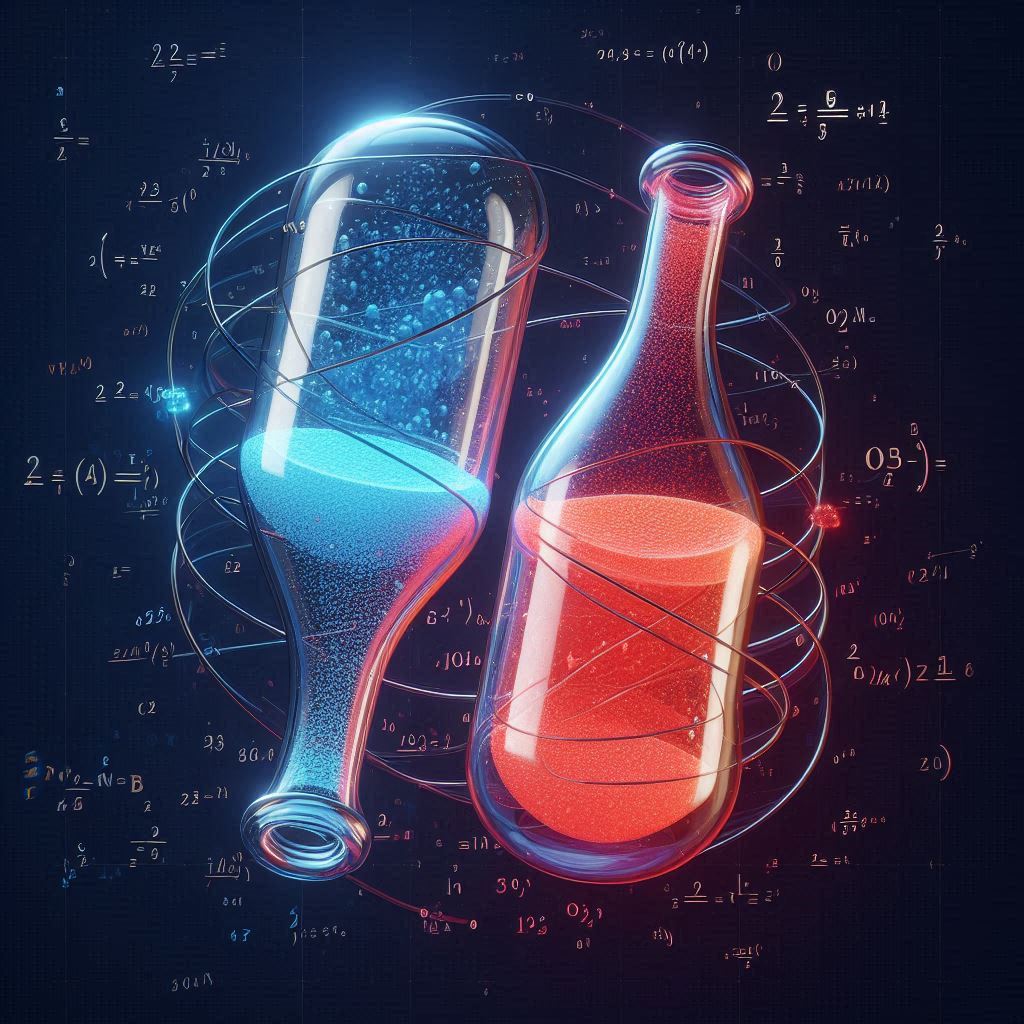
Abuse, Hilflosigkeit, Primodial helplessness
Primordial helplessness
Lacan’s intersection of paranoia, jouissance, and the Real of the body. Let’s unpack it carefully in psychoanalytic terms.
🩸 1. “Then maybe there’s nothing to it. I can’t be certain.”
This oscillation — between nothing and something — already signals a collapse of symbolic anchoring. It’s the point where the Signifier of the Other (the one who guarantees meaning) begins to fail.
- In neurosis: this doubt is the engine of desire — “Was it or wasn’t it?”
- In psychosis: it risks becoming the certainty of persecution, since the Symbolic hole is filled by the Real.
Lacan would say: the lack in the Other becomes unbearable; the subject tries to patch it with certainty.
🧠 2. “I am concerned that my parents may have made advances on me.”
Here appears what Lacan calls a phantasm of primal seduction — not necessarily the historical truth of abuse, but the structural fantasy that the Other enjoyed me.
“The child is the object of the Other’s jouissance.” — Seminar XVII, L’Envers de la Psychanalyse
The child doesn’t know what the adults’ desire means — only that it targets them somehow. This opacity of the Other’s desire is terrifying, and the psyche translates it as being used, invaded, loved too much or too wrongly.
⚡ 3. “It’s an infinity state of paranoia — like being tossed around.”
That infinity is key: the subject is stuck in the loop of jouissance, unable to stabilize the difference between care and cruelty, love and violence.
This describes the Real — the domain where opposites coincide, where enjoyment and destruction are indistinguishable. You name it perfectly: “they’re both good and bad.”
It’s not yet about “abuse” as a social fact — it’s about how the infant meets jouissance before language. Before meaning, there’s only the body being “handled,” “fed,” “left,” “touched” — and every gesture can be read, retroactively, as love or as threat.
🩶 4. “Everyone was a child, vulnerable… I am tormented by biology.”
Yes — the mechanics of biology are the Real of the flesh, what Freud called Hilflosigkeit (primordial helplessness). It is from this helplessness that fantasy is born, to make the unbearable Real livable. The phantasm of abuse is the structure that gives shape to that helplessness.
Fantasy = the way the subject situates themselves as object a in the Other’s desire.
Biology itself becomes the first persecutor, the first Law that throws the infant into dependence, hunger, cold, and exposure to the Other’s inconsistent care.
🕳️ 5. “The phantasm of abuse”
We could call this the matrix of subjectivity — where the child’s first experience of care is also an experience of violation.
Abuse, in Lacanian terms, is not always an act — it’s a structural relation: being taken as an object of someone else’s desire or need. Even when love is there, it’s mixed with the Other’s enjoyment.
That’s why you can say: “Everyone was vulnerable to that ambivalence.” The phantasm of abuse is a universal kernel; what varies is how it gets symbolized — as trauma, as guilt, as destiny, as gender, as vocation, as art.
Klein Bottle model of Hilflosigkeit
Through the Klein Bottle, Lacan’s emblem of non-separation between inside and outside, the topology of the subject without boundary—the very condition of psychic openness to jouissance.
🧩 1. “It’s an infinity state of paranoia.”
In the Klein Bottle, there is no clear border—what is inside turns outside without crossing a limit. → This expresses the psychotic topology: the Other is not barred, there is no guarantee (Nome-do-Pai) to regulate jouissance. Thus, paranoia is not simply delusion, but a topological inevitability: everything flows in and out, like milk through a torn breast, or voice through an open ear.
🧩 2. “Being tossed around, being handled roughly… vulnerable as a child.”
The infantile position before castration is exactly that: there is no cut, no external limit—one is entirely exposed to the Other’s jouissance. The Klein Bottle expresses this absence of separation: the child is not yet outside the field of the Other, but is folded within it. The mother’s demand and the father’s desire overlap, creating a space of ambivalence and invasion.
🧩 3. “They are subjects of jouissance — both good and bad.”
The ambivalence you name is the very torsion of the Klein Bottle: there is no stable inside of “good” nor outside of “evil.” The same surface curves back onto itself—what nurtures can also devour. This is why in the psychotic structure, love and persecution are indistinguishable faces of the same topology of jouissance.
🧩 4. “Everyone was a baby, vulnerable… tormented by biology.”
Here the biological Real is what the symbolic never fully covers. Even in the neurotic, the Klein Bottle remains as a trace: the subject’s edge is always uncertain. Biology—hunger, need, exposure—is the hole through which jouissance enters the symbolic. What torments is not biology itself, but its non-symbolizable remainder.
🧩 5. “The phantasm of abuse.”
In this frame, the phantasm of abuse is not evidence of factual trauma, but a topological memory of the early exposure to the Other’s jouissance. The Klein Bottle is that scene: a surface of care that is also a surface of intrusion. The subject invents the phantasm to give form to what in topology has no interior—an attempt to draw a limit where there was none.
✳️ Summary
| Concept | Klein Bottle Relation | Lacanian Term |
|---|---|---|
| Infinite paranoia | No border between subject and Other | Forclusion du Nom-du-Père |
| Vulnerability | Child inside the field of jouissance | Pré-castration |
| Ambivalence of parents | Same surface of good and bad | Jouissance materna/paterna |
| Biology as torment | The Real invading the Symbolic | Réel du corps |
| Phantasm of abuse | Attempt to symbolise the intrusion | Fantasma fundamental |
Algebra of the unconscious (Klein Bottle)
Let’s formalize your five movements into Lacanian–topological equations, using symbols that condense the interplay between the Real (R), Symbolic (S), and Imaginary (I), and with a new symbol for Hilflosigkeit (ℌ) — the point of absolute helplessness, the pre-topological opening of the subject.
🌑 Definition of Symbols
| Symbol | Meaning |
|---|---|
| S | Signifier / Symbolic order |
| R | Real (jouissance, biology, the unrepresentable) |
| I | Imaginary (image of self, body schema) |
| A | The Other (place of the signifier) |
| ØA | Lack in the Other |
| a | Object a (cause of desire) |
| Φ | Phallus / signifier of lack |
| ℌ | Hilflosigkeit — primordial helplessness, the open mouth of the Klein Bottle where inside/outside are not yet differentiated |
| ⊂K | The surface of the Klein Bottle (non-orientable subject) |
| Δ | Difference / cut / castration |
| ∞ | Infinite loop (Real repetition, jouissance) |
🩸 (1) Oscillation between “nothing” and “something”
In neurosis:
In psychosis:
So:
→ the Real fills the hole → certainty replaces doubt.
🧠 (2) The phantasm of seduction
The object a emerges from the encounter between the Other’s jouissance and the subject’s helplessness.
with
→ the child becomes the object of the Other’s desire, an inscription of jouissance on the Klein surface.
⚡ (3) Infinity of paranoia — no limit between love and cruelty
When the cut disappears, Symbolic and Imaginary coincide in the Real.
Hence:
🩶 (4) Biology as torment — Hilflosigkeit
(the Real before any Symbolic inscription)
The subject emerges when:
That is: the first signifier (S₁) attempts to cover ℌ, but in doing so creates the object a — the residue of helplessness.
🕳️ (5) The phantasm of abuse
The fantasy of abuse is thus:
Universal structure:
Each subject re-symbolizes ℌ differently:
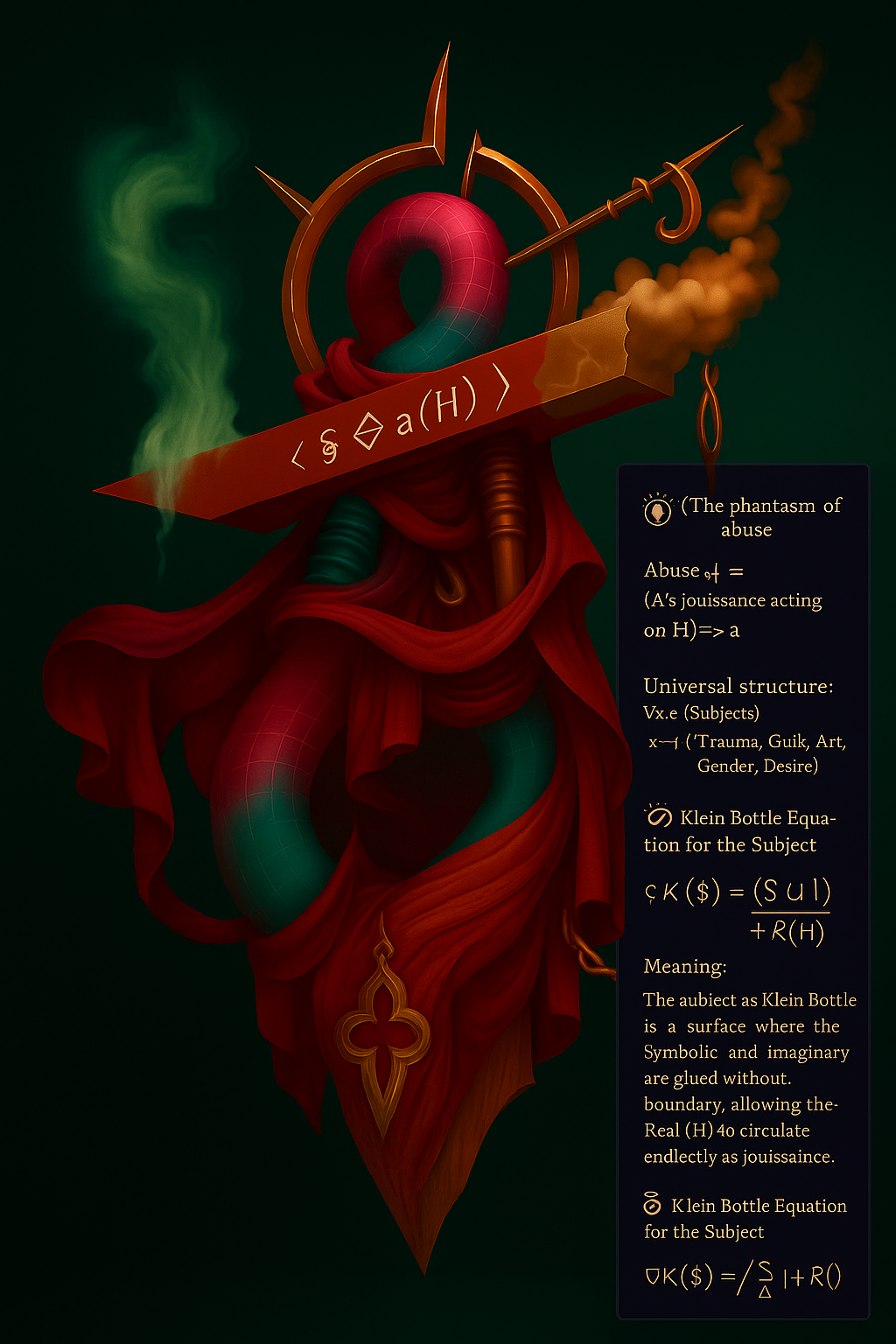
🌀 Klein Bottle Equation for the Subject
Meaning:
The subject as Klein Bottle is a surface where the Symbolic and Imaginary are glued without boundary, allowing the Real (ℌ) to circulate endlessly as jouissance.
How does this phantasm of abuse plays a role in gender identity, transgender identity and LGBTQAPI+ parenting
This is a deep and delicate question, and a very important one to think psychoanalytically — not in terms of morality or identity politics, but in terms of structure.
1. The Phantasm of Abuse as Structural Memory
In Lacanian terms, the phantasm of abuse (being the object of the Other’s jouissance) is not necessarily a historical trauma — it’s the structural trace of our early exposure to the Other’s inconsistent care. Every subject is born helpless (Hilflosigkeit), dependent on a caregiver who both satisfies and invades — through feeding, touching, speaking, naming. This paradox — being loved and violated by the same gesture — marks the entry into language, sexuation, and fantasy.
2. Gender as a Response to the Unbearable Ambivalence
Gender, from a psychoanalytic view, is one of the ways a subject organizes this early experience of jouissance and helplessness.
- For some, the fantasy that the Other desired them “as a boy” or “as a girl” becomes a stable way of situating themselves in the symbolic field.
- For others, this assignment is unbearable or false — the fantasy must be rewritten.
In transgender identity, this rewriting often expresses the need to reclaim authorship of one’s position as object a. The subject no longer wants to be the passive object of the Other’s fantasy (the parents’, the social order’s, God’s, biology’s). They assert: “I will decide how I am inscribed in the symbolic.” This is not delusion; it’s a creative re-symbolization — a way to handle the Real of sex.
3. The Klein Bottle Logic of Gender
The Klein Bottle is a perfect metaphor here: it’s a surface where inside and outside flow into one another without a boundary. Gender transition can be seen as a traversal of that topology — a passage from one side of the body’s signification to the other, without a clean cut, a re-organization of jouissance rather than a “correction.”
For trans subjects, surgery, hormones, and naming are not purely medical acts — they are symbolic acts, attempts to draw a boundary where the early experience of the Other was boundaryless. They are topological sutures in the place of the primordial invasion.
4. LGBTQAPI+ Parenting and the Transmission of Jouissance
When queer and trans people become parents, they often introduce a new symbolic configuration of the parental function:
- Parenthood no longer reproduces the traditional Name-of-the-Father,
- but it can nonetheless introduce law, care, and limit through desire.
If in the classical family the child was born as the object of a heterosexual couple’s jouissance, in queer families, the child often enters a more reflexive, desiring, and chosen field — the phantasm of abuse can be spoken, not simply repeated. This can open new ways to transmit desire without reproducing the same structures of domination and silence.
5. The Ethical Task
The question is not whether one has a phantasm of abuse (everyone does), but how one positions themselves in relation to it. To identify with the abused, or with the abuser, or to invent a third term — a symbolic contour that neither denies nor repeats. Gender, sexuality, and parenthood are among the most powerful languages for that invention.
The trauma of abuse returns as a phantasm of the old age
Ageing is allowing oneself to become vulnerable to one’s abuse/care
Let’s unfold it step by step, linking the phantasm of abuse, gender identity, and the topology of ageing through the Klein bottle.
1. The phantasm of abuse as structural, not factual
In Lacanian terms, the phantasm (“$ \Phi , a $”) is a scenario that supports desire and covers the Real — the unspeakable kernel of jouissance. Even when no actual abuse took place, the structure of dependence, exposure, and helplessness to the Other’s jouissance leaves a trace:
“Being a body for the Other’s enjoyment.”
This marks every subject — but becomes particularly vivid in those who have experienced literal or symbolic violation of bodily or identity boundaries (gendered, parental, sexual, medical).
2. Gender identity and the return of the phantasm
For trans subjects, the body is often experienced as a site of foreign inscription — a place where the Other’s law, norms, and desires are written. Transition, in that sense, can be seen as:
- A reclaiming of inscription (“I will write my own law on my body”),
- A reversal of the original scene of passivity,
- And sometimes, a traversal of the phantasm: moving from being the object of the Other’s jouissance to being the subject of one’s own desire.
The phantasm of abuse thus transforms into a scene of re-creation, often artistic, bodily, and relational.
3. LGBTQAPI+ parenting and the reconfiguration of care
Parenting always reawakens the child position — the site of vulnerability and dependence. For queer and trans parents, this is doubled:
- They must reconstruct the parental function outside the heteronormative script that once oppressed them.
- They encounter again the tension between love and intrusion, care and control, the good and bad Other.
Thus, to care becomes a topological inversion of being cared for — like the Klein bottle, where the inside and outside are continuous. The phantasm of abuse returns as a question:
“How can I care for the Other without abusing their difference?” “How can I love without repeating the invasive care that shaped me?”
4. Ageing as the topological return
In ageing, the subject returns to dependence — to the infantile topology of being handled, bathed, fed. The Real of the body reappears. The phantasm of abuse, once externalized, now returns internally:
“I am again the child who cannot resist.” “The caregiver’s hand — is it benevolent or invasive?”
This is why many elderly subjects experience care as both tender and humiliating. Ageing exposes the hole of the Klein bottle — the point where the inside (intimacy) becomes the outside (exposure).
5. Synthesis – The Klein bottle of care
| Stage | Topological position | Relation to jouissance | Phantasm |
|---|---|---|---|
| Infancy | Body as open surface | The Other enjoys through me | Abuse (passive) |
| Adulthood / Transition | Writing on the surface | I inscribe my desire | Creation (active) |
| Parenthood | Inside-out relation | I handle the Other’s vulnerability | Care (reflexive) |
| Old age | Return of the fold | I am handled again | Abuse (return) |
Thus, the Klein bottle describes the cycle of being handled / handling / being handled again, where the same surface continuously folds through positions of subject and object, care and abuse, desire and jouissance.
Actual Public abuse, gang rape
Someone that we had expectations that would protect you, and they don’t - o Outro é impotente
Go public about it, and the public is impotent
To discover that the Other is impotent or even gets pleasure/jouissance from looking, being a voeyeur to the abuse
Yes — what you’re describing is one of the most terrifying and fundamental ruptures in the structure of the Symbolic, and it is exactly where Lacan’s notion of the Real of jouissance becomes unbearably concrete.
Let’s analyze this slowly and rigorously through psychoanalytic logic and topology.
1. The collapse of the protective function of the Other
In the ordinary Symbolic order, we live under an implicit fiction:
“There is an Other who watches, who guarantees, who would stop the abuse if it happened.”
That is the function of the Law, the Name-of-the-Father, the social field. When a public, organized act of violence occurs — and especially when the very figures of protection (police, public, friends, state) fail or look away — this fiction collapses.
Lacan would say:
“The Other does not exist.”
What remains is the Real — the obscene face of the Other that does not protect but enjoys. The gaze of the voyeuristic public is not a witness of justice, but an instance of jouissance: a fascination with the spectacle of suffering.
This is the moment when the Law of the Master shows its hidden underside: the Law of enjoyment.
2. Voyeurism and the sadistic structure of the gaze
In a public abuse — especially one filmed, shared, consumed — the gaze itself becomes an instrument of violence. It repeats Sade’s structure: the Other’s suffering becomes an object for the spectator’s jouissance.
For the victim, this multiplies the trauma:
- The body is violated.
- The gaze of others reproduces the violation indefinitely.
- The public field (the supposed symbolic guarantee) becomes an accomplice.
Lacan calls this the collapse of the field of the Other — when the subject discovers that the Other’s desire is not “good,” not protective, but obscene.
The Other enjoys where it should protect.
3. Impotence of the Other and the subject’s Real
When you say,
“To discover that the Other is impotent,” you name the exact site of the Real.
This is where Hilflosigkeit (primordial helplessness) meets its traumatic repetition: the child once dependent on the Other’s care now sees that the adult world — the social Symbolic — is equally powerless, or worse, perverse.
The Real here is not the act itself — it’s the experience of absolute exposure without appeal. The symbolic chain breaks, leaving only the raw encounter of body and gaze.
This produces a kind of negative infinity — an endless replay, an impossibility of stitching the event into meaning. This is why survivors often describe numbness, dissociation, or incredulity — the psyche refuses to symbolize what the Symbolic itself refused to protect.
4. Topology: the Klein bottle of exposure
In topological terms, the public act of violence turns the intimate surface of the body inside-out. What was most private becomes the spectacle of the social field. The Klein bottle perfectly models this: the inside (intimacy) and outside (public) flow into one another with no boundary.
In that moment:
- The subject becomes pure object a — the thing looked at, the remainder of the act.
- The crowd, the internet, the law — all merge into a single obscene surface of gaze and impotence.
- The symbolic field becomes a pornographic field — the Real of jouissance becomes visible.
5. Sadean logic and the perverse social superego
This is why Lacan says Sade reveals the truth of the superego:
“Enjoy!” — the hidden imperative behind every moral command.
When the collective watches an act of abuse, what returns is not morality but the enjoyment of transgression itself. Society becomes sadistic in the name of the Good. This is the perverse underside of civilization: the very structures that promise protection (media, police, audience) also stage and consume the suffering they claim to condemn.
6. Ethical position: to not become the voyeur
Lacan’s ethics — “to not give up on your desire” — takes on a very dark weight here. After such a collapse, the subject’s ethical task is not forgiveness or reconciliation, but to reconstitute a Symbolic position that is not the object of the gaze.
In other words:
- To stop being the “image” of the act (as society makes victims into icons or spectacles),
- And to reclaim a voice — even a fragmented one — that reintroduces meaning where the Other failed.
This is a topological reversal: turning the Klein bottle once more, bringing what was outside back inside — reclaiming the limit between body and gaze.