

Theory Clinic
Theory and Clinic of Psychosis
Seeking the patient’s certainty that he is elsewhere is an element in the diagnosis of psychosis. Ba…
Seeking the patient’s certainty that he is elsewhere is an element in the diagnosis of psychosis. Based on this idea, one avoids confusing hysteria and psychosis.
The element of certainty that the patient has, both of entering another phase of his existence and that his hallucinations are real, is completely different from the style of hysteria. The more uncertain he is about whether he is in a dream or awake, the more remote the possibility of true psychosis becomes, which is characterized by the patient’s certainty and not by the idea that the world revolves around him, that he does not know his place and that he tries to identify with the world in order to stay grounded. This is not the style of psychosis.
The elementary Lacanian distinction between imaginary and symbolic can serve as a powerful clinical …
The elementary Lacanian distinction between imaginary and symbolic can serve as a powerful clinical tool in distinguishing between psychosis and neurosis. The neurotic, although he tends to display a multitude of more or less significant conflicts with friends and colleagues – that is, with others similar to himself – usually makes it clear to the therapist, from the first sessions, that his main complaint is about the symbolic Other. This may be expressed through complaints about parents, authority figures, social expectations or self-esteem problems, all of which suggest a conflict at the level at which the patient sees himself, in terms of the ideals of the Other (that is, at the level of his ego ideal or superego), as unsatisfactory, insufficient, guilty.
The psychotic, on the other hand, presents things differently: the conflict seems to be with others of his own age – rivals, competitors or lovers. They are not all trying to obtain the approval of the same authority figure; rather, one of them is usurping the psychotic’s place
In psychosis, just as the imaginary is not overwritten by the symbolic, the drives are never hierarc…
In psychosis, just as the imaginary is not overwritten by the symbolic, the drives are never hierarchized in the body, except by imitation. In other words, the hierarchy that may be apparent is not irrevocable: it does not represent as definitive a sacrifice of enjoyment as the hierarchy that the neurotic undergoes during socialization, and in which the libido is channeled (more or less completely) from the body in general to the erogenous zones. - - The erogenous zones. Only in these zones does the body remain alive, in a certain sense, or real. In them, the libido (or enjoyment) is channeled and contained. This is not what happens in psychosis: the hierarchy of drives that is obtained imaginarily can collapse when the imaginary order that sustains it falters. The body, which for the most part has been freed from enjoyment, is suddenly flooded by it, invaded by it. And enjoyment returns violently, we would say, because it is quite possible for the psychotic to experience it as an attack, an invasion or a break-in.
The psychotic may express shame, but not guilt. Guilt requires repression: one can only feel guilt w…
The psychotic may express shame, but not guilt. Guilt requires repression: one can only feel guilt when one knows that one has secretly wanted to inflict harm, or has taken pleasure in doing so. In psychosis, nothing is repressed, so there is noThere are secrets kept from oneself. - - The psychotic, however, repeats the same phrases over and over again; repetition replaces explanation. The “dialectic of desire” has no place. There is no truly human desire in psychoses. Where the structure of language is lacking,desire is also lacking. Where repression is lacking – where transparency has not given way to opacity, with regard to my thoughts and feelings, which results from repression –, questioning and intrigued reflection are also lacking: I cannot question my past, my motivations or even my ideas and dreams. They simply exist.
Direction of treatment
With the psychotic, however, the therapist must encourage this activity of creating meaning, because…
With the psychotic, however, the therapist must encourage this activity of creating meaning, because the ego is the only thing that can be worked with: the therapist needs to build in the psychotic a sense of self that defines who he is and what his place in the world is. He finally managed to find a place for himself in a world of his own creation.
I will not go into this text, because I have decided today, as you have seen from the beginning, to …
I will not go into this text, because I have decided today, as you have seen from the beginning, to work without a safety net. - - You will not tell me that I also explain everything. I do not explain anything, precisely. In fact, that is what interests you. I try on several levels, and not only here, to ensure that there are psychoanalysts who are not imbeciles. My operation here is an operation of direction, not in order to attract to a school vacuum, but to try to give the equivalent of what psychoanalysts should have to people who have no means of having it. It is a desperate initiative. But experience proves that the other, that of teaching psychoanalysts themselves, also seems doomed to failure, as I have already written.
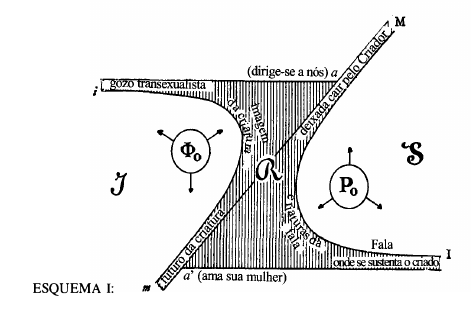
“Scheme of the structure of the subject at the end of the psychotic process” . This scheme is a vari…
“Scheme of the structure of the subject at the end of the psychotic process” . This scheme is a variation of the previous one: the foreclosure of the Name-of-the-Father, which entails the absence of the representation of the subject S by the phallic image, unbalances the relationship between the three fields: divergence of the imaginary and the symbolic, reduction of the real to the gap between them. The point i of the delusional ego replaces the subject, while the Ideal of the Ego, I, takes the place of the Other. The path Saa’A transforms into the path iaa’I.
Painting
Treatment of the real by the real in which a jouissance is deposited that is transformed until it becomes “aesthetic”, as they say, while the produced object imposes itself on the real.
There are other types of solutions that do not use the symbolic, but carry out a real operation on the real of enjoyment not imprisoned in the network of language. This is what the work is like — pictorial, for example — when it does not play with the verb, but gives birth ex nihilo to a new, unprecedented object —
In psychosis, especially, the painting has the function of serving as food for the thirsty gaze of t…
In psychosis, especially, the painting has the function of serving as food for the thirsty gaze of the Other that aims at the being of the subject. The subject makes the painting in order to try to deposit, fix, and divert from himself thedeadly gaze of the Other. This is what Octávio Inácio shows us, who transforms the bem-te-vi into a well-seen drawing, transferring the accusatory look that emerges in reality to his phallic, winged and equine characters. Thus, painting allows us to shift this gaze that irrupts into the field of the subject’s reality to monitor and punish him. Placing your gaze on the screen to better frame it can be the equivalent of an attempt to cure delirium, when you are offered the possibility of doing so, as allowed by Nise da Silveira, the pioneer. The consequence of the pictorial act is a pacification of the enjoyment that invades the subject with the watchful gaze and the voice of the insult that comes from the Other. This seems to me to be the basis for the improvement of psychotic subjects who dedicate themselves to a pictorial activity.
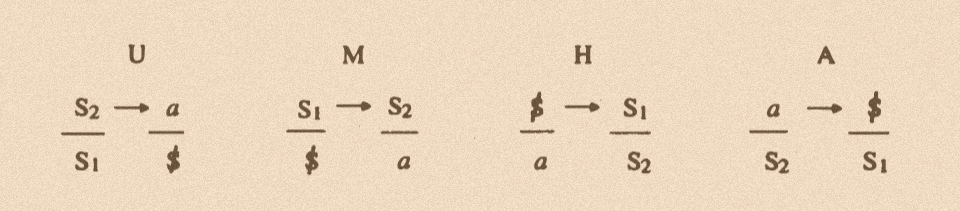
Work, elaborate, speak, write, record
Social ties
Govern, Manage, Monitor, Count