
Psychoanalysis era trans
Transsexuality and estrangement of the body
About resources for sex change - Luciana Ribeiro Marques - Gisele Lavianas…
About resources for sex change - Luciana Ribeiro Marques - Gisele Lavianas
Vinicius Müller
Certainly the penis, the imaginary support of the phallus, has an operative function in this process…
Certainly the penis, the imaginary support of the phallus, has an operative function in this process, functioning for the being of language as the object of desire at the level of having, since it is the only organ of the body capable of guiding the subject: desire confessed with erection and absent with detumescence. Thus, the refusal of the penis on the part of the transsexual reveals itself as a refusal of the erection of the penis, through which the man’s desire is presented. The claim for the penis is no different, although it does not resolve the issue, as the penile prosthesis does not replace the organ of desire, as it is not capable of the magical properties that this organ reveals. The fact is that, although the offer of surgical resources aims to link body and gender, promising a harmonious encounter between the subject and their sex, in sexuality there is a real at stake that is not symbolized, remaining unspeakable.
Although they confirm the estrangement with the body , they wish to maintain the biological genital …
Although they confirm the estrangement with the body , they wish to maintain the biological genital organ, while others see, as the only recourse in the face of estrangement, submission to sexual reassignment surgery. In most cases, aesthetic repairs and the use of hormones are the resources used by transsexuals who do not seek reassignment surgery. They also modify their body in order to conform it to the appearance of the sex with which they identify, but, even though surgery is available, there is no demand, and they keep the sexual organ, supporting their gender with semblance, a possible resource to human. However, for others, the estrangement of the body goes beyond the possibility of using the semblance and culminates in the demand for genital surgery as a conviction. In these cases, transwomen refuse the penile organ and aim for its extirpation, while transmen claim the penile prosthesis as a substitute for the organ of desire.
With Freud, we know that the choice of a partner, whether homosexual or heterosexual, is unconscious…
With Freud, we know that the choice of a partner, whether homosexual or heterosexual, is unconscious and takes place in two stages: the primary, Oedipal choice, and the consequent alloerotic choice in adult life. The Oedipal affective current corresponds to the child’s choice of primary object, whereby affection for the parents does not exclude the erotic nature of this relationship, since, with the contribution of sexual drives, the child is taken as the erotic object of their caregivers. However, with the elision of this primordial romance, based on the obstacle established by the barrier against incest, affective fixations remain and help to lead eroticism to the deviation from its original sexual objects; now inadequate.
In this way, Oedipus implies both the loss of jouissance, interdiction and the unconscious choice of…
In this way, Oedipus implies both the loss of jouissance, interdiction and the unconscious choice of a partner. Or, in another way, there is no primacy of the genital drive, since the drive is the product of the incidence of language on the body, articulating the signifiers with the erogenous zones, partial drives that ratify solitary and limited jouissance, in which two they don’t make one. Therefore, body and jouissance are regulated by language and, although the new objects ofadult life are chosen based on the traits of primordial objects, in body-to-body there is no possible sexual relationship, as copulation can only be achieved through language: “the bodies they copulate because words copulate in the unconscious, in language. (…) There are not only obsessions, conversions, etc., the couple itself, a couple of jouissance, is a symptom. Both at the level of jouissamce and at the level of the partner chosen by the unconscious”
Heterosexuality, regardless of the sex of the chosen partner, since, whether the subject is a man or…
Heterosexuality, regardless of the sex of the chosen partner, since, whether the subject is a man or a woman, what is at stake is the difference, the partner as the object that causes the subject’s desire .
When we move towards this central void , given that it is, until now, in this form that access to jouissance appears to us, the body of the next person falls apart .”
Anatomy is not capable of protecting the subject from the question of the Other’s desire. The phallu…
Anatomy is not capable of protecting the subject from the question of the Other’s desire. The phallus, the signifier of lack, although it can be based on body image, allowing the sexual being, through speech, access to appearance, will never be reduced to it. Che vuoi? This is the question around which the subject, referred to the Other, as a mark of otherness, tries to anchor the answer about their own sex. Therefore, being a man or a woman is not an anatomical question, but a choice made by the subject, an unconscious choice of sex in the face of the corporeal effects produced by the incorporation of the symbolic, a mark that produces its shape beyond any silhouette to be surgically remade, to in addition to any transplant or sex removal.
In the aspiration of what it means to be a man or what it means to be a woman, since the phallus is …
In the aspiration of what it means to be a man or what it means to be a woman, since the phallus is the obstacle to reaching the Other sex — which escapes language, remains in the register of reality and makes the meaning of sexual functions impossible —, what remains for men, they seem to have it, a pure semblance through which they try to protect themselves from lack, and for women, they appear to be it, a semblance of an object as a resource for the Other’s desire.
Freud had already highlighted the narcissism of the organ (Freud, 1927/2011) when referring to the c…
Freud had already highlighted the narcissism of the organ (Freud, 1927/2011) when referring to the castration anxiety that affects boys without any relation to a real threat, coming from the outside. The fact that the boy loved their penis from the first erections is what ingrains the fear of its loss. As for the girls, there is a realization of the lack, a wound in the image of the body that produces the Penisneid and the consequent anguish of loss of love, “because the girl considers themself, even for a moment, castrated, in the sense of deprived of the phallus, and castrated by the operation of someone, who is first and foremost their mother, an important point (…)” (Lacan, 1958/1998, p. 687).
Thus, the feminine position presents itself as a possible resource before the Other. To resort to th…
Thus, the feminine position presents itself as a possible resource before the Other. To resort to the feminine mask is to be the phallus that the Other desires, since, by adhering to the impossible of being, the feminine countenance reveals castration through the identification of women with the lack-to-have, a denunciation of castration without covering the lack, specific to the sexual position of women, capable of revealing the feminine countenance par excellence. However, in relation to jouissance, it is important to emphasize that, even in the place of cause for their partner, in the place of object a, they are left with phallic jouissance, marked by the impossibility of making One. Therefore, by positioning themselves as having or being the phallus, men and women try to make up for the lack of sexual relation, remaining on the path of phallic jouissance, where the incompatibility between being and having resides.
Hence psychoanalysis operates within the exception , against the promise of a common good for all, w…
Hence psychoanalysis operates within the exception , against the promise of a common good for all, with norms and principles that exclude differences. Psychoanalysis, by supporting an ethical discourse , guided by what is most unique and most intimate in each subject, points to the only path to the unconscious, testimony of desire, which is based on absolute difference, centered on the real.
the only organ in the body capable of showing desire the subject: erection/detumescence
the estrangement with the body, gender and appearance
“bodies copulate because words copulate in the unconscious, in language. .…. There are not only obsessions, conversions, etc., the couple itself, a couple of jouissance , is a symptom. Both at the level of jouissance and at the level of the partner chosen by the unconscious”
the partner as an object cause of the subject’s desire, emptiness, shattering
Anatomy is not capable of protecting the subject from the question of the Other’s desire.
Pure countenance, semblance
the narcissism of the organ
make up for the lack of sexual relation
Exception and an ethical discourse
Intertwining between nomination and legal law
Notes on the change of civil name by transgender people - Eduardo Brandão…
Notes on the change of civil name by transgender people - Eduardo Brandão
Based on a case fragment, I defend the hypothesis that the change of civil name is the answer that t…
Based on a case fragment, I defend the hypothesis that the change of civil name is the answer that the subject seeks to position themself in a given sexual position. Changing their first name provides symbolic support that singularizes and at the same time represents them to the Other. To this end, one cannot lose sight of the difference between the subject of the statement and the subject of the enunciation, as well as between legal law and symbolic law.
The subject of the statement and the subject of the enunciation : at the level of the statement, the…
The subject of the statement and the subject of the enunciation : at the level of the statement, the subject makes their being prevail, that is, their identifications: “I am this or that”; in the enunciation, the subject is beyond or below the identifications, suspecting the deceptive character of the fantasy that supports them.
The unconscious creates something beyond identifications, the jouissance of which makes the subject adhere to them.
The vast majority of transgenders who come to the Court with a request to change their civil name us…
The vast majority of transgenders who come to the Court with a request to change their civil name usually go through the transsexualization process beforehand — not necessarily surgery, but at least hormone therapy — which, according to Ministry of Health Ordinance No. 2,803, of 2013, expands this procedure in the Unified Health System (SUS), requiring, due to its irreversible nature, that the patient meets the requirements of majority, psychotherapeutic follow-up for at least two years, favorable psychological/psychiatric report and diagnosis of transsexuality. Thus, such subjects often arrive at the Judiciary assessment having already gone through a long trajectory of elaboration on their own subjective condition.
In turn, the surname is what identifies the origin, indicating the lineage and highlighting the fami…
In turn, the surname is what identifies the origin, indicating the lineage and highlighting the family transmission to the children. The first name marks the individual, constituting a sign of social identity, while the surname places the bearer as a member of a certain family group, being a newborn or adopted (Carvalho & Chatelard, 2016). In a single sentence, the first name particularizes and the surname collectivizes.
To the extent that the civil registration name distances itself from the body, its image and, above all, its gender identity, the subject becomes vulnerable not only to physical violence, but also to symbolic violence represented by the gaze of others .
When the child is born, the Other who takes care of they will enable the transmission of the signifi…
When the child is born, the Other who takes care of they will enable the transmission of the signifiers that articulates them with the genealogical chain, delimiting the passage from the state of nature to culture. To the extent that no subject can bring themselves about, the Other is the place of significant cause.
The symbolic father is a legal fiction — whose surname attributed to someone establishes an act of f…
The symbolic father is a legal fiction — whose surname attributed to someone establishes an act of faith, as only the mother knows who the progenitor is, despite science’s claim to provide some certainty from the sperm. It is a fiction of language that is based on the Name-of-the-Father, which, in turn, is not identical to the patronymic, nor does it depend on the father in reality, that is, on the progenitor in the flesh. In this context of discussion, Safouan observes that the desire depends not only on the weight that the mother gives to the Father’s Name, but also on the way this father deals with the law: “that is, as someone who authorizes themself by it, or as their author themself (in which authority becomes imposture)”
Identification with the trait seeks to deal with the void left by the original absence of the object…
Identification with the trait seeks to deal with the void left by the original absence of the object , consequently engendering the relationship between the subject and the signifier. The primitive vocalization of the infans gives phonetic status to the trait, however, at the moment the signifier is engendered, writing already functions as a latent operation in the subject’s own act of enunciation. The letter, as the impossibility of representation by a signifier, is what makes a hole in the symbolic. It is what allows for significant inscription, at the same time as it gives rise to the recording of writing.
If the signifier is located on the side of the symbolic, the letter is on the side of the real.
In the masculine field, the subject is specified by maintaining a relationship with jouissance stric…
In the masculine field, the subject is specified by maintaining a relationship with jouissance strictly in the field of phallic , limited jouissance. The subject positioned in the feminine, on the other hand, attends not only the phallic jouissance, but one beyond it, called the jouissance of the Other , unlimited, a supplementary jouissance, it is worth highlighting, regardless of the male and female body anatomy. Following this reasoning, could we think that Marcelo seeks to side with male jouissance as a means of dealing with female jouissance? What would be the expected operation with the change of civil name? Would changing the first name have the function of providing material support for the difference that singularizes it, a condition that is at the same time fundamental for the representation of the subject in the Other’s desire?
The given name for which he seeks to obtain civil recognition would have been invented as a signifie…
The given name for which he seeks to obtain civil recognition would have been invented as a signifier, because there would be something there to be read — the trait — with which the subject identifies.
By way of hypothesis, the name change can complete an operation for which the bodily change was not sufficient, namely, placing the subject in the masculine position to deal with invasive jouissance, even though we know that there will always be a refractory remainder to the phallus .
The child and the choice of sex
The Other’s speech conveys the interpretation of their sex…
The Other’s speech conveys the interpretation of their sex.
The as if personalities, studied by Helene Deutsch, illustrate how the subject can construct an imaginary sexual identity conforming to the image of their sex, which facilitates the social bond and bond with the partner, but its consistency is often fragile, not enough in the moment of truth of sexual melee. In the clinic, we find cases that testify to a solution that engages the jouissance linked to the body and that does not pass through the signifier.
At first, Hans was very worried about this part of his body — his penis. He begins a kind of inquiry…
At first, Hans was very worried about this part of his body — his penis. He begins a kind of inquiry into who has and who doesn’t have a penis, and a game of exhibitionism ensues between the child and his mother. Hans is in the place of the object of his mother’s desire—the phallus—in a position to fill what she lacks. He spends his time showing off his penis and looking at his mother’s body, in which the scopic dimension is prevalent. Lacan evokes Hans’ happiness in this period, in which he learns to give pleasure to his mother by offering the phallus in his own person. This paradise comes to an end with the birth of the sister and especially with the intrusion of a masturbatory jouissance that becomes real. The child is confronted with “the gap between satisfying an image and having something real to present”. From this irruption of jouissance comes anguish, and phobia sets in.
The symptom comes as the subject’s response to the encounter with sexual reality, a specified realit…
The symptom comes as the subject’s response to the encounter with sexual reality, a specified reality that there is no sexual relationship, because, in this encounter, the subject only confronts the object of their or they own jouissance. To say that there is no sexual relationship is to say that there is a phallic function, as Lacan says in 1972: “phallic jouissance is the obstacle through which man cannot enjoy the woman’s body, precisely because what he enjoys is the jouissance of the organ”
If we can deduce that sexual orientation and object choice are established in childhood, what would …
If we can deduce that sexual orientation and object choice are established in childhood, what would be the distinction between adult and childhood sexuality?
In other words, if there is a difference, it does not refer to the status of jouissance, nor to that…
In other words, if there is a difference, it does not refer to the status of jouissance, nor to that of the object. - It all comes down to the fact that childhood is the time for the first time of all essential experiences: an encounter with the discourse of the Other and an encounter with experiences of jouissance, a notion that is designated as original trauma. Time of the first experiences of sexual reality. what is at stake does not concern anatomical reality. The first experience of jouissance can have the effect of perplexing the subject when the operation of repression does not operate.
Adult sexuality is realized with a real partner, in the moment of truth in sexual melee. This has co…
Adult sexuality is realized with a real partner, in the moment of truth in sexual melee. This has consequences at the level of fantasy, in that it is enough for the infantile neurotic subject to construct a fantasy that supports the desire , giving a formula, the desire of the Other, which testifies to a subjectification of castration. For adults, this is not enough, as they will have to operate with fantasy during the sexual act, which involves objectifying castration. The encounter with castration, aimed at the sexual act and jouissance, can relaunch the anguish and the formation of a symptom. - There is only the symptom to be happy”
Demoulin relies on the symptom considered as the way in which each person enjoys their unconscious :…
Demoulin relies on the symptom considered as the way in which each person enjoys their unconscious : each one with their symptom, which sustains them in existence, which forms their way of jouissance and their identity in the separation with the primordial Other. Symptom that fixes desire and can make a singular destiny. This is where psychoanalysis can operate.
Name, symbol, symbolic support
elaboration on their own subjective condition.
Name, surname, symbolic violence
To the extent that no subject can found themself , the Other is, for they , the place of their significant cause.
Identification with the trait seeks to deal with the void left by the original absence of the object
Phallic jouissance, Other jouissance
By way of hypothesis, the name change can complete an operation for which the bodily change was not sufficient, namely, placing the subject in the masculine position to deal with invasive jouissance, even though we know that there will always be a refractory remainder to the phallus .
The subject of the statement and the subject of the enunciation
The Other’s speech conveys the interpretation of their sex.
inquiry into who has and who has not
The symptom comes as the subject’s response to the encounter with sexual reality
sexual orientation and object choice are established in childhood, what would be the distinction between adult and childhood sexuality?
everyone jouir their unconscious
Surplus Jouissance
Everyone jouir their unconscious
Psychoanalysis in the Trans era
Antonio Quinet
For psychoanalysis, being is stole away, and where it could appear, the semblant of being appears, w…
For psychoanalysis, being is stole away, and where it could appear, the semblant of being appears, which Lacan locates with the name object a — a product of the hunt for the real by signifiers. When it comes to genders, conventional cultural formations of masculine and feminine, it is not about being, but about appearing. There is no male or female in being.
In the early days of psychoanalysis, in correspondence with Fliess, Freud already pointed out the no…
In the early days of psychoanalysis, in correspondence with Fliess, Freud already pointed out the non-existence of sexual relations as the basis of neurosis: trauma is the hole between beings. The sexual trauma detected by Freud is reread by Lacan as a mismatch of sex, which he calls the non-existence of sexual relations. This hole in the relationship between two sexual beings is properly speaking the trauma already detected by Freud as an inadequacy between desire and jouissance, during the mythical first encounter with the real of sex: indifference or disgust in hysteria, and excess and self-recrimination in obsessional neurosis . Encounters, yes, but relationships, no. In sex: just grating.
There are two myths that Lacan proposes in The Aturdito (1972/2003) to refer to the two sides of the…
There are two myths that Lacan proposes in The Aturdito (1972/2003) to refer to the two sides of the sexuation formulas, or, as he calls it, the two “halves of the subject”. The myth of Oedipus , on the side of the all phallic, and the myth of Tiresias, on the side of the phallic not-all. On the so-called man’s side, the formulas of the Universal and the One respond logically to the myth of Totem and Taboo, a substitute invented by Freud for the myth of Oedipus and the incest taboo. The Universal of “all subjected to castration” is combined with the One-of-the-exception-that-says-no to the phallic function, that is, that says no to castration. On this side, at the bottom, we find the desiring subject, whose structure Freud detected precisely in the myth of Oedipus — the subject who desires their mother with their father as an obstacle, so he kills they and achieves their object of desire, becomingking of Thebes. The myth of Oedipus is represented theye by and by Φ, scepter of the power of royalty, of knowledge, of the search for truth. Oedipus: the conqueror; Oedipus: the phallus; Oedipus: the king. But, upon discovering thetruth about his crimes, Oedipus gouges out their eyes and is exiled, thus moving from the position of subject to object-waste, losing the crown, the kingdom, the scepter and power.
Tiresias , the blind seer Tiresias is the character who, in Sophocles’ play, presents themself as th…
Tiresias , the blind seer Tiresias is the character who, in Sophocles’ play, presents themself as the Master of Truth, blind and soothsayer, capable of deciphering the riddles and omens coming from the gods. It is to they that Oedipus turns to decipher the origin of the plague. According to mythology, when he was young, while walking on Mount Cithaeron, Tiresias came across two copulating snakes. When he hits them apart, he transforms into a woman. Seven years later, when he passes by the same place, he finds snakes copulating again and, when he does the same, he becomes a man again. Due to this unusual experience of having met both sexes, Tiresias was called by Zeus and theya to give their opinion on a quarrel between the couple. Who enjoys sex more: the man or the woman? Tiresias said that a woman cums nine times more than a man. theya, upon seeing the feminine secret revealed in this way, became angry and blinded him. Zeus, to console him, gave him longevity (to live for seven generations) and the gift of divination.
The main characteristic, therefore, of Tiresias is that of knowing feminine jouissance, that jouissa…
The main characteristic, therefore, of Tiresias is that of knowing feminine jouissance, that jouissance of the Other, beyond the phallus and speech, obscure and opaque, that women keep in the secret of the ineffable — this is their great clairvoyance. It is this experienced jouissance, beyond language, that allows they to be Master of Truth, which, like The woman, is not-all. The power of divination to see beyond appearances is related to the enigma of Other’s jouissance.
The myth of Tiresias is a myth of a man who experienced female jouissance. Myth of trans — from beyond the phallus, from the confines of jouissance Another that is enunciated through logic and represented in the myth of Tiresias who made themself, who became the Other. This is the place to which Lacan, giving voice to the Sphinx, calls us like Oedipus to come.
Come to this trans-phallic place to be able to manage the mantic of dreams and the game of significa…
Come to this trans-phallic place to be able to manage the mantic of dreams and the game of significance in the analytical interpretation on the bed of the absence of sexual relation. - Tiresias, The blind-gaze, sees beyond appearances , is the bearer of a trans gaze, a translucent gaze, on the side of the not-all, as it is reduced to the object a in its scopic function. Tiresias is also in the place of The Woman Who Doesn’t Exist (LA barred F) and, because he has access to this jouissance, he knows about the holes of women and the pores of men [S(A barred)]. Tiresias had contact with the divine, What-transcends, and has access to the jouissance of the Other, manipulating symbols, reading the flight of birds, deciphering the timelessness of desire in the past, present and future.
The confrontation between Oedipus and Tiresias, in Oedipus the King, by Sophocles, is the clash of t…
The confrontation between Oedipus and Tiresias, in Oedipus the King, by Sophocles, is the clash of the all-powerful (phallic, rich, king, conqueror, fathomable, young) against the blind old man (ragged, without threshing floor or edge) and who, however, , is the owner of a mysterious and enigmatic knowledge, which reveals the destiny of Oedipus — whom the phallus of power prevents from having access to the not-all truth and the trans-phallic jouissance of the poetic manipulation of language (which is precisely what allows Tiresias to prophesy). - It is to this place that the analyst is called: allowing the subject to cross the barrier of sex and experience themselves as a semblance of object a.
Thus, the sexual difference reread from the formulas of sexuation is the difference between jouissan…
Thus, the sexual difference reread from the formulas of sexuation is the difference between jouissances, between positions and between arguments that make someone say they are on the side of the all phallic and the not-all phallic side, on the side of the squad or outside of it. This is the radical difference between the One and the Other. This difference, which is sexual, has a name: heterogeneity. And the relationship to sex is the modality of argument with which each subject responds to the phallic function.
Forced choice, referring to significant alienation. Based on the latest developments in Lacanian the…
Forced choice, referring to significant alienation. Based on the latest developments in Lacanian theory, we can also talk not only about the choice of homo or hetero sexual orientation, but also about the choice of modes of jouissance and gender appearances. Talking about choice always implies ethics. Treating modes of jouissance as choices is addressing this issue, so central in our trans era, without any of these choices being pathologized or linked to some clinical structure, or reduced to an effect of capitalist discourse, or an effect of advances in science, or still the effect of a supposed epidemic of collective hysteria.
The crossing of fantasy consists of going to the other subjective pole, which is object a, that whic…
The crossing of fantasy consists of going to the other subjective pole, which is object a, that which fundamentally determines us. This crossing is combined with the passage from the all phallic to the not-all phallic; leaving phallic logic, the totemic, so-called patriarchal universe, the universe of Oedipal identities and identifications, to the non-universe, the transfinite; to the area of lalangue, creation and poetry.
The analyst’s place is the place of the not-all . The non-place, as the place of no-reason, of the a…
The analyst’s place is the place of the not-all . The non-place, as the place of no-reason, of the absence of sexual relations, of disidentity, of the pure semblance of object a, the very place of the beyond, beyond the ONE, beyond EVERYTHING, and everyone. It is exactly the place TRANS — which is a prefix used in certain words to designate the beyond, the au-delà, and through.
Thus, the transition to analyst in an analysis, in addition to crossing fantasy, is a trans-passage, a trans-formation, beyond any format or formation. There where it overflows, transcends, trans-writes. Trans-passage made possible by love, this trans love that is trans-ference. We should, therefore, change the name from Analyst Training to Analyst Trans-formation. And thus, being able to fulfill our trans-mission of psychoanalysis.
It’s not about being, but about seeming
Encounters , yes, but relationships, no. In sex: just grating.
Oedipus myth
Tiresias sees beyond appearances
myth of a man who experienced female jouissance
overcome the barrier of sex and experience oneself as a semblance of object a.
sexuation formulas
In the field of “sexual identification” what dominates is hesitation, the question.
sexual position and gender appearances
The crossing of fantasy
The analyst’s place is the place of the not-all
Surplus Jouissance
Cross the barrier of sex and experience oneself as the semblance of object a.
Clinical reports
Dandara Vital:1 “Actually, it took me a while to identify as a woman—trans. I always thought I was …
Dandara Vital:1 “Actually, it took me a while to identify as a woman—trans. I always thought I was a gay man. The first thing that bothered me was the hair… because my mother, she is… they nickname is naked,because she barely has any hair. Male features were things that bothered me, but the thing that bothered me most was the fur.”
Fabiana Tanigucci Gondo:2 “Always a feeling that something was wrong, always a feeling of not being complete… quite divided, not knowing how to resolve this incongruity between my mind and my body. There was always a concern of mine not to let it show so as not to disappoint my parents.”
Patrícia:3 “Ever since I was a child, around 3 years old, I no longer felt good about my body. I fel…
Patrícia:3 “Ever since I was a child, around 3 years old, I no longer felt good about my body. I felt some strange things, I saw that I was different from other people. I always wore clothes hiding my body, I always wore clothes below the knee and long-sleeved blouses… I wore a coat because I didn’t like my body and wanted to hide it.”
Johi:4 “I discovered that I was a transsexual when I was 20 years old, it took a while. But, before that, I never identified with the feminine… in fact, I saw myself lost… I didn’t know how I was going to live like this, I just lived… I survived.”
Leonard:5 “I usually say that I was born a boy, but, in society, if you are born with a vagina, you are classified as a woman… I lived my entire life as a ‘lesbian’, understand? But I felt like something was missing in my life. So… I met an ex of mine who helped me… showed me transgender people in the USA… and, when I looked at a photo, I said: That’s it! I saw the body, right? So, I said: this is what I want.”
Yuri Branco:6 “There is a difference between when I know exactly what is happening and when I feel t…
Yuri Branco:6 “There is a difference between when I know exactly what is happening and when I feel this way. I was always a different child. I was born a woman, biologically, and when I was a child I was always kind of mistaken for a boy… my mother talks a lot about this, this issue of how I already had this as a child, ever since I was a baby. So much so that she thought I would always be born biologically male.”
There must be evidence of a strong and persistent identification with the opposite gender (…) (Crite…
There must be evidence of a strong and persistent identification with the opposite gender (…) (Criterion A). This identification (…) must not reflect a mere desire for any perceived cultural advantages of being of the other sex (…) (Criterion B). The diagnosis is not made if the individual has a concomitant physical intersexual condition (…) (Criterion C). For this diagnosis to be made, there must be evidence of clinically significant distress or impairment in social or occupational functioning or other important areas of the individual’s life (Criterion D).
Dandara Vital: “Actually, I got caught up in hormones on my own. Craziness! I started when I was 23,…
Dandara Vital: “Actually, I got caught up in hormones on my own. Craziness! I started when I was 23, 24 years old. But I really started to dress, like, in a feminine way, to put on makeup, which were things I had wanted to do for a while, when I looked in the mirror and really saw what I wanted to see. I used industrial silicone, right? I put it in my house with a bomber. I put it on my chest and hips.”
Fabiana Tanigucci Gondo: “Mom’s clothes, cousin’s clothes… and then, as I got older, I let my hair grow. Until I reached adulthood, I only explored in this way, I never had the courage to go beyond those limits, everything was always hidden… and always with a certain guilt. I had surgery on my face, a cut, a reduction in the angle of my jaw… making my face more feminine. The other intervention was filler in the cheek area, which gave a delicacy to the face, then came the body, breast implants and abdominoplasty. Lastly, the gender reassignment surgery, which I had in Thailand. I have to be honest, because I haven’t tried it yet… I haven’t fully recovered yet and I haven’t tried, let’s say, the new equipment.”
Patrícia: “The first time I took hormones I was 15 years old. I started to take care of myself… I …
Patrícia: “The first time I took hormones I was 15 years old. I started to take care of myself… I felt different from everyone in my family, I felt strange, as if I had two souls inside me, but it wasn’t that, it was the soul that didn’t correspond to the body. When I got excited, I wanted to cut myself off. I didn’t like being excited, it irritated me, I got really angry, it bothered me a lot, to the point where, I don’t know, it got in the way of my life. That’s very strange, I still can’t get used to it… it feels like you’re trapped. It’s you being trapped in a body that isn’t yours. That’s practically it, you’re in prison, because you don’t know what you did.”
Johi: “Until I was 11 years old, I wore my brother’s clothes or went shirtless. It wasn’t until I wa…
Johi: “Until I was 11 years old, I wore my brother’s clothes or went shirtless. It wasn’t until I was a teenager, when I started to build my body, that my mother started to ask me not to wear my brother’s clothes anymore, and I tried to wear feminine clothes… I usually say that I felt betrayed by my body. I felt vulgar, I felt dirty, strange, and I didn’t look at myself in the mirror, I didn’t really look at myself. In part, it was resolved, because I had a masculinizing mastectomy… it was a freedom for me… because it was a place where we wore bandages and such, so it gets stuck, hurts the body, and I ended up with health problems. Furthermore, I started to have social phobia… thinking that people were looking at me. I was already followed within the market, at the beginning of the transition, and in several places. But, in relation to the genitals, unfortunately, I still have to accept what is there, because surgery theye is impossible. In Brazil, it is very complicated, the result is not satisfactory. Unlike trans women, who are already free. For me, I would do all the surgeries.”
Leonard: “When you look in the mirror and say: wow, I’m not in my body! I usually say that I adjusted everything that was in my head, I started taking hormonal treatment. The genital area, for me, has never been a problem. No, it was never anything… with the genitals, nothing, nothing. It’s the organ that we are born with, understand?”
Yuri Branco: “In the beginning, I was very… I don’t think it’s repulsion, but I didn’t accept it ver…
Yuri Branco: “In the beginning, I was very… I don’t think it’s repulsion, but I didn’t accept it very well. I think it’s a very personal question… how do you feel about your organ, right? I don’t want to have surgery, but I have. I see that the human being is much more than their genitals. I am a man, regardless of what I have or don’t have. I’ve been taking hormone therapy for three years or so. I only had breast surgery. I didn’t feel like doing anything else.”
Monthly monitoring of the user in the pre- and post-operative transsexualization process; hormonal d…
Monthly monitoring of the user in the pre- and post-operative transsexualization process; hormonal drug therapy; sexual reassignment in males with bilateral orchiectomy (surgical removal of the testicles) with amputation of the penis and neocolpoplasty (construction of a neovagina), thyroplasty (surgery to reduce the Adam’s apple with a view to feminizing the voice and/or lengthening the vocal cords ), hormonal treatment preparatory to sexual reassignment surgery; simple bilateral mastectomy (resection of both breasts with repositioning of the nipple-areola complex), hysterectomy (removal of the uterus) with adnexectomy (removal of the fallopian tubes and ovaries) and colpectomy (removal of the vagina); bilateral reconstructive breast plastic surgery, including silicone breast implants; clinical care provided by a multidisciplinary team and complementary surgeries.
Choosing a partner
Man, woman, body - Voluptium and Beatitude - God and Immortality: future - Free will - Knowledge…
Man, woman, body - Voluptium and Beatitude - God and Immortality: future - Free will - Knowledge
Dandara Vital: “I consider myself heterosexual. He [her current boyfriend] is a trans man… He had al…
Dandara Vital: “I consider myself heterosexual. He [her current boyfriend] is a trans man… He had already kissed others, but had never had sex. And the other two I kissed… it wasn’t that interesting. Then, with my boyfriend, the first time we kissed we started the chemistry.”
Fabiana Tanigucci Gondo: “The attraction… my orientation… has always been lesbian, let’s put it that way, my gender identity has always been female, and my attraction has always been directed towards the female sex.”
Patrícia: “Heterosexual. When I was 12… it was with my cousin. I felt uncomfortable in relation to the sexual organ, you know? To stay the way it was. But I already liked that kind of thing… only with boys, you know? I was never attracted to girls.”
Johi: “I consider myself pansexual… people have a habit of coming up and wanting to ask what the p…
Johi: “I consider myself pansexual… people have a habit of coming up and wanting to ask what the person has between their legs, you know? Pansexuality doesn’t have that. I’m not sexually interested inmen, only in women, regardless of whether I’m a cis woman or a trans woman or a transvestite. My girlfriend is a transvestite.”
Leonard: “My girlfriend is a woman. She is cisgender. I consider myself pansexual. The person who does me good, makes me happy and I like the person, that’s it.
Before they, I was in a relationship with a gay boy, understand? He was cisgender too… it doesn’t matter.”
Yuri: “Woman, always. I have always had relationships with women. So… I’m straight, heterosexual, right? I always liked women and never had anything to do with men.”
Dandara Vital: “The difference… I think it’s in rights. Being a woman is much more difficult in term…
Dandara Vital: “The difference… I think it’s in rights. Being a woman is much more difficult in terms of conquering your space. But I’m very traditional… I think due to upbringing, strict religion. I really have this thing that pink is for women and blue is for men… I’ve always suffered prejudice for being a transvestite, so I can’t say if I’ve ever suffered prejudice for being a woman. It’s difficult to answer this difference between men and women… I’m trying to deconstruct myself.”
Fabiana Tanigucci Gondo: “It’s difficult… I can only solve it in a practical way in my daily life. I think something is funny, being a woman allows you to be a little ruder to people. When you are a man and you argue with another man, there is always that possibility of a physical confrontation. So, men learned to have more limits. Then I discovered something: why are women, in general, more arrogant? Because these limits with women don’t exist that much. With me, I don’t even feel the issue of fragility, because physically I haven’t changed, I’m still big, I’m still a brown belt in karate… I don’t feel fragile anymore these days.” Patrícia: “I don’t know what it means to be a man, do you understand? Because it’s something I’ve never been. I only know what it’s like to be a woman, and being a woman is difficult. Being a trans woman, on the other hand, doesn’t always have its good sides, it’s a lot that goes on, you know? You don’t accept yourself in your own body, that kind of thing, and you don’t feel good about the body you have.”
Johi: “I think there’s no difference for me… it’s a question of self-identification. I don’t like to…
Johi: “I think there’s no difference for me… it’s a question of self-identification. I don’t like to highlight physique, appearance… that’s nothing… we change that, right?”
Leonard: “To be a man or to be a woman? To be a man or to be a woman? (…) That’s what I was trying to remember… what is being a man? What do I aim for? The genital organ, the penis. So, to be a man, you don’t need the organ, understand?Or to be a woman… identification does not need to be in the genital organ. I think that’s what being a man is, and that’s what being a woman is.”
Yuri: “I think it’s a matter of feeling. I can’t imagine being a man, nor when they say woman can I imagine being like a woman.
I think it’s a question of how the person feels and how they behave… I can’t imagine a mold.”
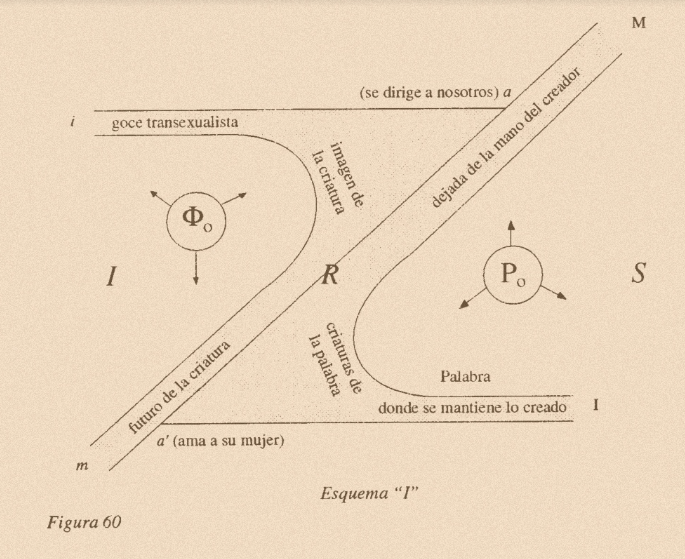
Brought into the world by parents
Surplus Jouissance , Body
Creature future, procreation
How do I maintain myself while I