

Machines desire esquizophrenia e psychoanalysis
Desiring Machines, Schizophrenia and Psychoanalysis…
Desiring Machines, Schizophrenia and Psychoanalysis
I. Desiring Machines
Desiring Production
The Body without Organs
The Subject and Enjoyment
Materialist Psychiatry
Machines
The Whole and the Parts
II. Psychoanalysis and Familism: The Holy Family
The Imperialism of Oedipus
Three Texts by Freud
The Connective Synthesis of Production
The Disjunctive Synthesis of Registration
The Conjunctive Synthesis of Consumption
Recapitulation of the Three Syntheses
Repression and Repression
Neurosis and Psychosis
The Process
III. Savages, Barbarians, Civilized
Socius Inscritor
The Primitive Territorial Machine
The Oedipus Problem
Psychoanalysis and Ethnology
Territorial Representation
The Barbarian Despotic Machine
Barbarian or Imperial Representation
The Urstaat
The Civilized Capitalist Machine
Capitalist Representation
Oedipus, Finally
IV. Introduction to Schizoanalysis
The Social Field
The Molecular Unconscious
Psychoanalysis and Capitalism
First Positive Task of Schizoanalysis
Second Positive Task of Schizoanalysis
Appendix: Balance-Program for Desiring Machines
Relative Differences between Desiring Machines and Gadgets
Desiring Machine and Oedipal Apparatus
Machine and Full Body
Fixation on Oedipus - Body, parts, unity - Production, Recording, Consumption - Social Field…
Fixation on Oedipus - Body, parts, unity - Production, Recording, Consumption - Social Field
Theory of Knowledge
Capitalism tends towards a threshold of decoding that undoes the socius in favor of a body without organs and that releases, on this body, the flows of desire in a deterritorialized field. Is it correct to say, in this sense, that schizophrenia is the product of the capitalist machine, just as depressive mania and paranoia are products of the despotic machine, or as hysteria is the product of the territorial machine?
When we say that schizophrenia is our disease, the disease of our time, we are not simply saying that modern life is driving us crazy. It is not a question of a way of life, but of a process of production. Nor is it a simple parallelism, although this is more accurate from the point of view of the failure of codes, such as, for example, the parallelism between the phenomena of slippage of meaning in schizophrenics and the mechanisms of growing discord at all levels of industrial society. In fact, we mean that capitalism, in its process of production, produces a formidable schizophrenic burden upon which it places the full weight of its repression, but which does not fail to reproduce itself as a limit of the process. This is because capitalism never stops opposing, inhibiting its tendency, at the same time that it rushes into it; it never stops pushing away its limit, at the same time that it tends towards it.
It is certainly not in relation to drives that one can give sufficient current definitions of the neurotic, the perverse and the psychotic, but in relation to territorialities.modern realities, since drives are nothing more than the desiring machines themselves. The neurotic remains installed in the residual or factitious territorialities of our society and bases them all on Oedipus as the last territoriality that is .43. reconstructed in the analyst’s office, on the full body of the psychoanalyst. Of course, the boss is the father, the head of the State too, and you too, doctor… The pervert is the one who takes the artifice literally: since that’s what they want, they must have territorialities infinitely more artificial than those that society proposes to us, they must have new, infinitely artificial families, secret and lunar societies.
As for the schizo, with his hesitant step, which never stops migrating, erring, slipping, he plunges ever further into deterritorialization on his own body without organs, until the infinity of the decomposition of the socius, and perhaps the schizo’s walk is his particular way of finding the earth again. The schizophrenic is situated at the limit of capitalism: he is its developed tendency, the surplus product, the proletarian and the exterminating angel. He mixes all the codes, he is the bearer of the decoded flows of desire. The real flows. The two aspects of the process come together: the metaphysical process that puts us in contact with the “demonic” in nature or in the heart of the earth, and the historical process of social production that restores to the desiring machines an autonomy in relation to the deterritorialized social machine. Schizophrenia is the production of desire as the limit of social production. The production of desire and its difference in regime in relation to social production are, therefore, at the end and not at the beginning. From one to the other there is only one becoming, which is the becoming of reality. And if materialist psychiatry is defined by the introduction of the concept of production into desire, it cannot avoid establishing in eschatological terms the problem of the final relationship between the analytical machine, the revolutionary machine and the desiring machines.
The cuts operate extractions on the associative flow. Like the anus and the flow of shit that it cuts; the mouth and the flow of milk, but also the flow of air and the flow of sound; the penis and the flow of urine, but also the flow of sperm.
It is only in relation to the body without organs - eyes closed, nose pinched, ears blocked - that something is produced, counter-produced, diverting or exasperating all the production of which it is nevertheless a part. But the machine continues to be desire, a position of desire that continues its history through the original repression and the return of the repressed, in the whole succession of paranoid machines, miraculous machines and celibate machines that Joey goes through as Bettelheim’s therapy progresses.
How could there be a partial extraction of a flow, without a fragmentary disconnection in a code that will inform the flow? We said, a moment ago, that the schizo is at the limit of the decoded flows of desire; it would be necessary to understand, in this way, the social codes, since,in these, a despotic Signifier crushes all chains, linearizes them, bi-univocalizes them, and uses bricks as if they were immovable elements for an imperial Chinese wall. But the schizo always highlights them, disconnects them and takes them with him in every sense to rediscover a new plurivocity, which is the code of desire. Every composition, as well as every decomposition, is made with mobile bricks.
Producing desire is the sign’s only vocation, in every sense in which this is engineered.
The introduction of desire into neurology.
Subject and Residue.
Melanie Klein made the wonderful discovery of partial objects, this world of explosions, rotations, vibrations. But how can we explain that she does not, however, understand the logic of these objects? The thing is, first of all, she thinks of them as ghosts, and judges them from the point of view of consumption, not of real production. It indicates mechanisms of causation (introjection and projection), of effectuation (gratification and frustration), of expression (good and bad), which impose an idealist conception of the partial object. It does not link it to a true production process, which would be that of desiring machines. Secondly, it does not get rid of the idea that schizo-paranoid partial objects refer to a whole, whether this is an original in phase .53. primitive, either by coming in the posterior depressive position. the complete Object.
Partialobjects therefore appear to him to be extracted from global persons; not only will they enter into the totalities of integration concerning the ego, the object and the drives, but they already constitute the first type of object relationship between the ego, the mother and the father. Well, after all, that’s where everything is decided. It is true that partial objects possess, in themselves, a sufficient charge to explode Oedipus, to strip him of his foolish claim to represent the unconscious, to triangulate the unconscious, to capture all desiring production.
Partial objects are not representatives of parental characters, nor supports of family relationships; they are pieces in the desiring machines, they refer to a process and to irreducible relations of production, and they are first in relation to what is recorded in the figure of Oedipus.
When we talk about the Freud-Jung split, we often forget the modest and practical starting point: Jung noted that, in the transference, the psychoanalyst often appeared as a devil, a god, a sorcerer, and that his roles were singularly beyond parental images. Then everything started to go wrong, but the starting point was good. The same thing happens with children’s games. Children don’t just play mommy and daddy. She also plays wizard, cowboy, cops and robbers, trains and cars. The train is not necessarily daddy, nor the station, mommy. The problem does not lie in the sexual character of the desiring machines, but in the familial character of this sexuality.
It is accepted that, as a child grows up, he finds himself involved in social relationships that are no longer familiar. But how do you think these relationshipss .55. occur later, there are only two possible paths: either we admit that sexuality is sublimated or neutralized in social and metaphysical relations, in the form of an analytical “after”, or we admit that these relations bring into play a non-sexual energy, which sexuality was content to symbolize as an anagogical “beyond”.
This is where things went wrong between Freud and Jung. They have in common, at least, the fact that they believe that the libido cannot, without mediation, invest a social or metaphysical field. And that is not what happens. Let us consider a child who is playing or who, crawling, explores the rooms of the house. He looks at an electrical outlet, works on his body, uses one leg as an oar or a branch, enters the kitchen, the office, manipulates toy cars. It is obvious that the presence of the parents is constant and that the child has nothing without them. But that is not the point. The question is whether everything the child touches is experienced as a representation of the parents. From birth, the crib, the breast, the pacifier, the excrement, are desiring machines in connection with the parts of the child’s body. It seems contradictory to say that the child lives among partial objects and, at the same time, to say that the child apprehends parental persons in the partial objects, even if in pieces.
It is not strictly true that the breast is a detachment of the mother’s body, since it exists as a part of a desiring machine, in connection with the mouth, which extracts from it a flow of non-personal milk, thin or thick. Being part of a desiring machine, a partial object represents nothing: it is not representative. It is a support for relations and a distributor of agents; but these agents are not persons, just as these relations are not intersubjective. They are relations of production as such, agents of production and anti-production.
A question is posed to the child, which will perhaps be “reported” to the woman called mother, but which is not produced for her sake, but rather produced in the game of desiring machines, for example, at the level of the mouth-air machine or the tasting machine—what is living? what is breathing? what am I? what is the breathing machine in my body without organs? The child is a metaphysical being. As in the Cartesian cogito, the parents have nothing to do with it.
The child is always in the family; but, in the family and from the beginning, he or she immediately engages in an enormous non-familial experience that psychoanalysis overlooks.
Michel Foucault was able to point out to what extent the relationship between madness and the family is based on a development that affected the whole of bourgeois society in the 19th century, and which entrusted the family with functions through which the responsibility of its members and their possible guilt were assessed. Now, to the extent that psychoanalysis involves madness in a “parental complex” and rediscovers the confession of guilt in the figures of self-punishment that result from Oedipus, it does not innovate, but completes what 19th century psychiatry had begun: to erect a family and moralizing discourse.mental pathology, .59. linking madness to “the semi-real, semi-imaginary dialectic of the Family”, and in it deciphering “the incessant attack on the father”, “the silent opposition of instincts to the solidity of the family institution and its most archaic symbols”. Thus, instead of participating in an undertaking of effective liberation, psychoanalysis includes itself in the more general work of bourgeois repression, that which consisted of keeping European humanity under the yoke of daddy-mommy, and of not putting an end to this problem.
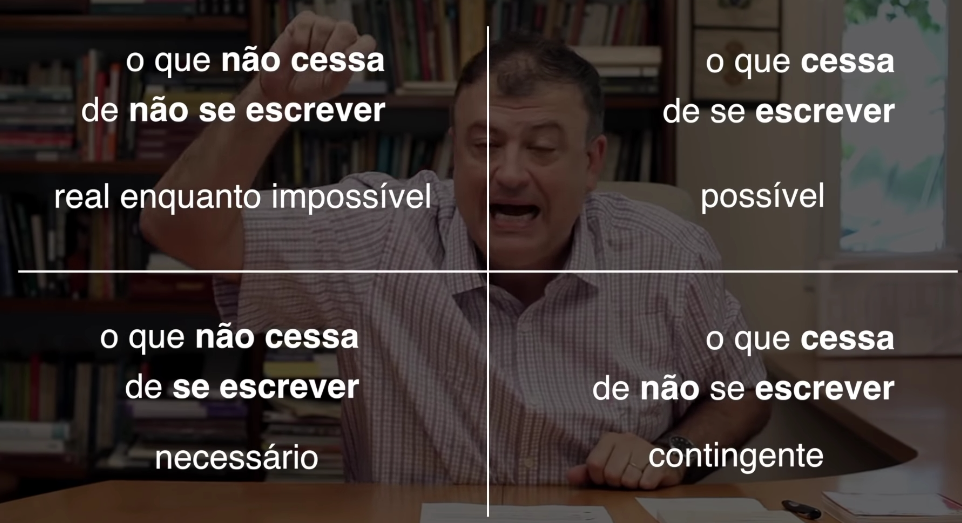
What we question is the furious oedipalization to which psychoanalysis indulges, whether practically or theoretically, with the combined resources of image and structure. And despite the fine books recently written by certain disciples of Lacan, we ask whether Lacan’s thought is oriented precisely in this direction. Is it simply a matter of oedipalizing even the schizo? Or is it something else, and even the opposite?36 Schizophrenizing, schizophrenizing the field of the unconscious, and also the historical social field, in order to explode the yoke of Oedipus and to rediscover everywhere the force of desiring productions, to reconnect in the Real itself the link between the analytical machine, desire and production? This is because the unconscious itself is neither structural nor personal; it does not symbolize, just as it does not imagine or figure: it machines, it is machinic. Neither imaginary nor symbolic, it is the Real in itself, the “impossible real” and its production.
The productive unconscious is replaced by an unconscious that knows only how to express itself — and express itself in myth, tragedy, and dreams. But who can tell us that dreams, tragedy, and myth are adequate to the formations of the unconscious, even if we take into account the work of transformation? Groddeck, more than Freud, remained faithful to a self-production of the unconscious in the coextension of man and Nature. It is as if Freud had retreated from this world of wild production and explosive desire and wanted to introduce a little order into it, at any cost, the classical order of the old Greek theater. What does it mean to say: did Freud discover Oedipus in his self-analysis? Was it in his self-analysis or in his classical Goethean culture? In his self-analysis he discovers something of which he says: look, this resembles Oedipus.
And he began by considering this something as a variant of the “family romance,” as the paranoid register through which desire precisely explodes family determinations. Only little by little does he turn the family romance, on the contrary, into a dependency on Oedipus, and neurotizes everything in the unconscious, while at the same time oedipalizing it, in which he encloses the entire unconscious in the family triangle.
The psychoanalyst becomes the director of a private theater — instead of being the engineer or mechanic who assembles production units, who struggles with collective agents of production and anti-production.
An expressive unconscious and no longer the formations of the productive unconscious
Everything follows from this, starting with the characterThe indescribable nature of the cure, its endless, highly contractual character, a flow of words in exchange for a flow of money.
So, what we call a psychotic episode is enough: a flash of schizophrenia, we bring our tape recorder into the analyst’s office one day — stop, intrusion of a desiring machine, and everything is subverted, we have broken the contract, we have not been faithful to the great principle of the exclusion of the third party, we have introduced the third party, the desiring machine in person.38 However, every psychoanalyst should know .66 that under Oedipus, through Oedipus and behind Oedipus, it is with the desiring machines that he must confront himself. At first, psychoanalysts could not be unaware of the forcing .effort. operated to introduce Oedipus, to inject him into the entire unconscious. Later, Oedipus settled on the production of desire, appropriated it as if all the productive forces of desire emanated from him.
The psychoanalyst has become Oedipus’ hanger, the great agent of anti-production in desire. The same story as that of Capital, and its enchanted, miraculous world. In the beginning, too, said Marx, the first capitalists could not be without consciousness…
Operation of the Psychoanalyst
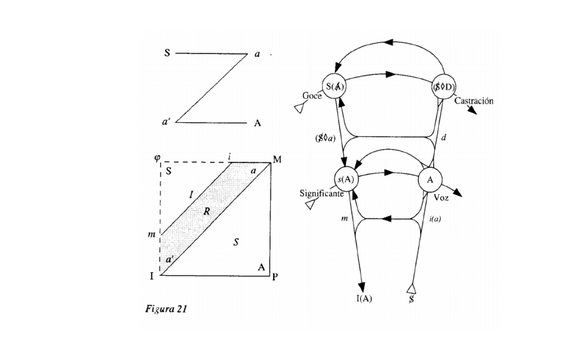
DiagnosisFree AssociationLocation of the Subject of the Unconscious. Cut
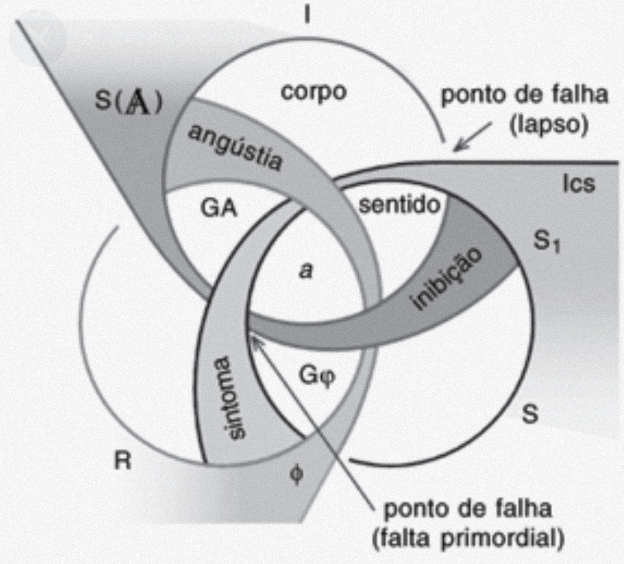
Less, more - Whole, pieces - Beautiful, Horror - Love, Hate - Debts, faults - Misunderstandings, del…
Less, more - Whole, pieces - Beautiful, Horror - Love, Hate - Debts, faults - Misunderstandings, delays - Being, seeming, dressing - Slow, unproductive, repetitive - Deposit, materiality, performance
Separate, non-separableFlow, non-flowWorks, does not workErrors, inaccuraciesInconsistent, incoherent, incompleteNot-One, not-whole, not-null
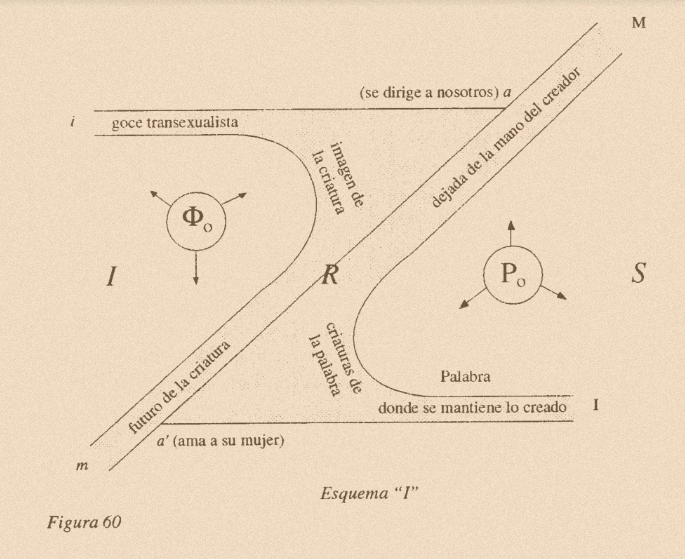
Brought into the world by parents
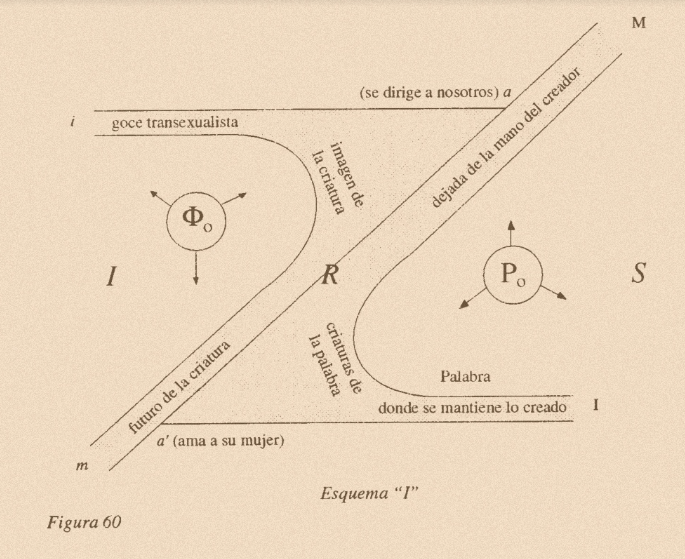
Future of the creature, procreation
How do I maintain myself while I
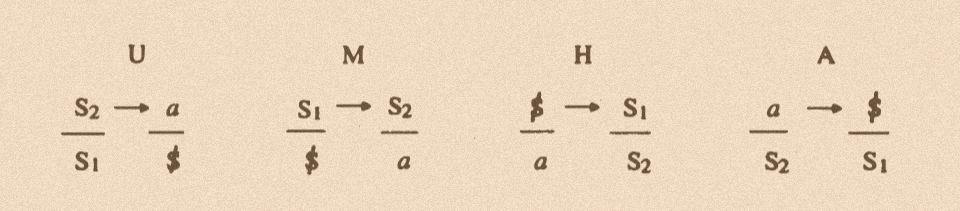
Social Bond: love, work and play - Object relations - Imaginary: Reduction of Inhibition, Shame…
Social Bond: love, work and play - Object relations - Imaginary: Reduction of Inhibition, Shame… Shame, Guilt before the Other, Disalienation from the Other, Helplessness, Strong Self: There is no guarantee - Clarification - Enjoyment - Authorship: Invention and Responsibility
End of my Analysis


Treatment direction strategies:
- The most identifiable are those that use a symbolic of substitution, which consists of constructing a fiction different from the Oedipal fiction and taking it to a point of stabilization, obtained by what Lacan once described as a metaphor of substitution: the delusional metaphor.
Algorithm for the Analyst
What am I asking for here? What are my demands? How many repetitions? What is the value invested? Stopping point