

Theory of Discourses
Social bond
Discomfort
Impossible professions
Real. There are some professions that are impossible: so governing and educating are professions in …
Real. There are some professions that are impossible: so governing and educating are professions in which no matter how well you do, no matter how dedicated you are, the task is still impossible. Impossible in the sense of unfeasible, that the difficulties you face when educating are so great that the result will leave something to be desired. That is why someone who was educated one day becomes a teacher and tries to repair, reconstruct what was done to him once. Based on this idea, Freud introduces a third impossible profession, which would be psychoanalysis, and Lacan introduces a fourth impossible relationship, which would be making people desire. So based on these four impossible actions, he describes discourses as social bonds. Every discourse creates a bond, and this bond is formed around an impossibility, this impossibility that Freud called discomfort.
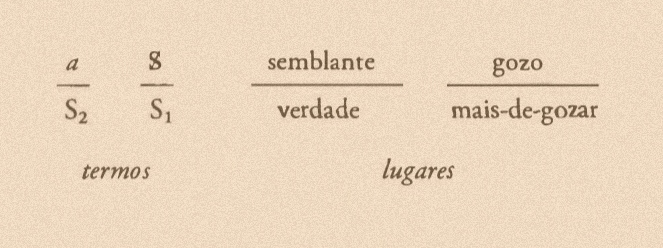
So these four places maintain an order among themselves, a circulation in such a way that vectors de…
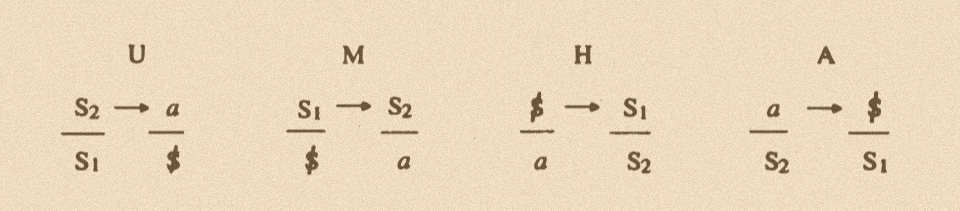
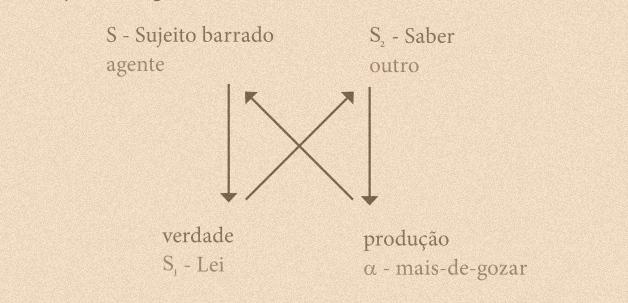
So these four places maintain an order among themselves, a circulation in such a way that vectors depart from the truth to the other sides of the discourse, but they never arrive in vectors. This means that each discourse has a place sheltered in the place of truth, a place that, once touched, transforms this discourse into another. So the place of truth supports the place of the semblance, or of the agent of a discourse. The agent relates to the other and extracts a production. For example, the joke, a pair of signifiers, an S1 that joins with an S2 and produces an effect of satisfaction, an additional one of enjoyment, laughter when the joke is successful and the joke is based on a truth that remains sheltered, half-said, unspoken, characterizing this first discourse that is the master discourse.

Working, elaborating, speaking, writing, recording
Social ties
Governing, Managing, Supervising, Telling
Master’s Discourse
Master-signifier, signifier of knowledge, object a, in the function of more than enjoying and the ba…
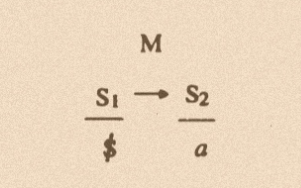
Master-signifier, signifier of knowledge, object a, in the function of more than enjoying and the barred subject, in the place of truth. What does the subject mean as the place of truth in the master’s discourse, that this cannot appear, no discourse of the master, discourse of power, discourse of force hides this constituent fact that there is a subject who puts it into practice, there is a divided subject, a castrated subject who organizes the relations between the master and the slave.
When the doctor finds himself compelled to stop, study and write to produce knowledge provoked by th…
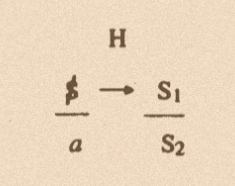
When the doctor finds himself compelled to stop, study and write to produce knowledge provoked by the patient’s case, we are in hysterical discourse.
The hysterical act is to make people desire, which shows something that we all experience, that is, that courting, seducing, attracting, and flirting creates social bonds. The act is always hysterical when it produces desire in the other, including the desire to know, and promotes the truth of sexual enjoyment.
Hysterical Speech
The analyst performs the function of a pure desiring condition (pure desiring subject), and interrog…
The analyst performs the function of a pure desiring condition (pure desiring subject), and interrogates the subject in its division, precisely at those points where the cleavage between the conscious and the unconscious appears: slips of the tongue, failed and involuntary acts, unintelligible speech, dreams, etc. In this way, the analyst leads the patient to work, to associate, and the product of this arduous association is a new master signifier. The patient, in a way, “expels” a master signifier that has not yet been related to any other signifier.
Analyst’s Speech
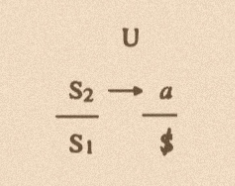
University Speech
Which is also the discourse of the bureaucrat, of the one who never takes responsibility for his act…
Which is also the discourse of the bureaucrat, of the one who never takes responsibility for his actions, of the one who refers his desire to the other, the dominant one is precisely knowledge, the signifier S2, below we have S1 and on the other side you will have in place of production the subject, which is the student, the one who will come to know, the one who will come to speak, the one who will finally become someone and in this position the object a which is how, in general, university discourse treats the other , as an object, an object to be molded, to be sculpted, in short to be formatted, studied as Lacan plays.

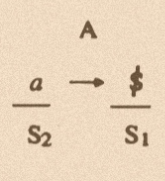
The psychoanalyst’s discourse has several peculiarities, he places in the place of the semblant or t…
The psychoanalyst’s discourse has several peculiarities, he places in the place of the semblant or the agent, the object a, which is the position of the analyst, is the one that places itself as the support for the patient’s fantasy, so if the patient places, If the analysand sees things, projects, we support that, we don’t deny it. On the other side, the analyst’s discourse will place precisely the subject, this practice of producing the otherro as a subject, a divided, castrated subject, a subject who does not want to be subjectivized in this natural and spontaneous position, below the bar we will have the s1, the master signifier that is the effect of the interventions that the analyst makes, he extracts the S1s, that signifier that controls a person’s life and that they discover in the analysis and become disalienated from that signifier. So the object a in place of semblance, the other occupied by the subject, the position of s1 is the effect of interpretation and here in place of truth there is knowledge, knowledge that is not known, the knowledge that would represent this impossible that characterizes truth. , in relation to what can be said about it, what can be written about it.
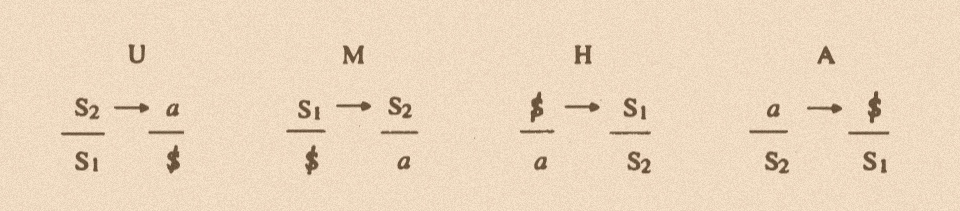
Discourses of impotence as a discourse of hysteria and as the discourse of the university x Discours…
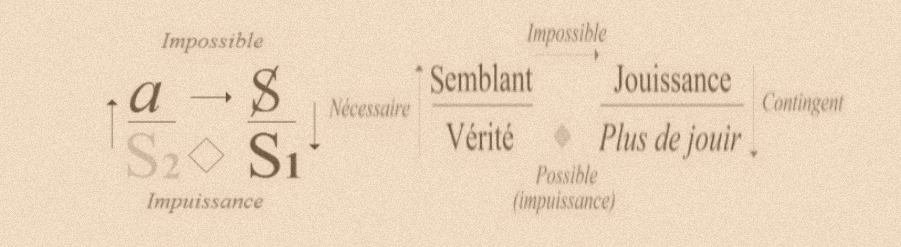
Discourses of impotence as a discourse of hysteria and as the discourse of the university x Discourses of impossibility as the discourse of the teacher and the discourse of the psychoanalyst. - This occurs due to this circulation that I am writing about, between the place of the agent, the place of the other, the place of truth, the place of production there is an impossibility or impotence. There is a path that we do not pass, that we cannot take, it is precisely this place where fantasy is located, in the case of the master’s discourse, and this place, this point of blockage, of impossibility that reality assumes within the speeches. - Discourses are social bonds characterized by the relationship with this impossible, this real internal to the discourse and which changes its aspect as we alter the social bond.
Capitalist discourse
The capitalist’s discourse is a discourse that does not propose the subject’s social bond with the o…
The capitalist’s discourse is a discourse that does not propose the subject’s social bond with the other, but rather with an object (a) manufactured by science and technology (S2). Here the subject is reduced to a consumer, and the object that causes his desire is a gadget. Completeness no longer with a person, but with a connectable and disconnectable partner within reach.
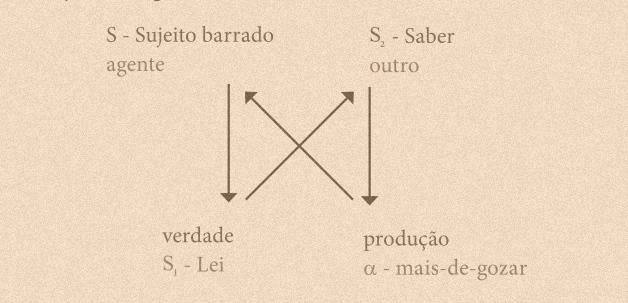
The society governed by capitalist discourse feeds on the manufacture of a lack of enjoyment, it pro…
The society governed by capitalist discourse feeds on the manufacture of a lack of enjoyment, it produces insatiable subjects who, in their demand for consumption, are never able to buy everything they supposedly want. It thus promotes a new libidinal economy. On the other hand, by placing surplus value in the place of the cause of desire - making you want to always earn more -, this society transforms everyone into a potential exploiter of their fellow man in order to obtain a profit from him.of an unaccounted surplus labor and wanting to take advantage of everything. Anything goes to make people consume more and more of the objects produced by scientific-technological capitalism. The DC creates a subject animated by “capitalist desire” and interprets its structural lack, lack-to-be, as lack-to-be-rich; and the lack-of-enjoyment is inscribed as the lack-to-have-money. Thus, the decapitalized subject is produced. The result of this is that the DC produces the defaulting subject, the subject of eternal debt: internal and external.
The capitalist discourse is not regulatory and institutive like the DM, it is segregating. The only …
The capitalist discourse is not regulatory and institutive like the DM, it is segregating. The only way to deal with differences in scientific-capitalist society is the segregation determined by the market: those who have or do not have access to the products of science. It is a discourse that does not properly form a social bond, it segregates - hence the proliferation of those without: land, shelter, employment, food, etc. - - Relationship between subject, object, other, social bond