Optic Scheme
Optical Scheme
Real and Virtual Image - Flat, concave and convex mirrors - Converging and diverging lenses - Image…
Real and Virtual Image - Flat, concave and convex mirrors - Converging and diverging lenses - Upright, inverted, larger or smaller image - Physical Properties - Equations
Theory of optics

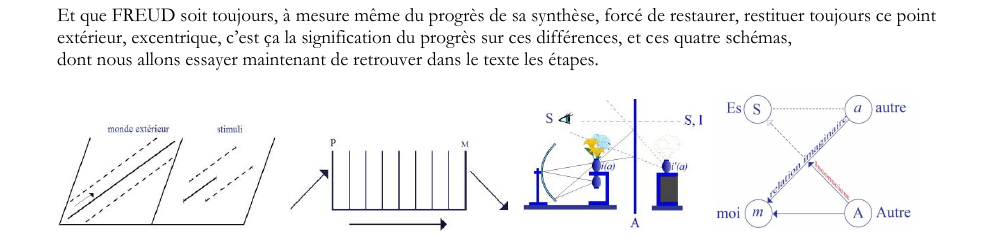

Imaginary
Constitution of the Subject
Notion of One - Formation of the Image - Effect, production of meaning, enjoyment - Mechanical unity - Center, machine…
Notion of One - Formation of the Image - Effect, production of meaning, enjoyment - Mechanical unity - Center, machine - Body and its organs - Dismemberment
Mirror Stage
Kant: The critique of pure reason
Understanding - Judgment - Reason: Reasoning -
Production of meaning - Both aggressiveness and love
Bodily Effects
Another body - Foreign body - President Schreber…
Another body - Foreign body - President Schreber
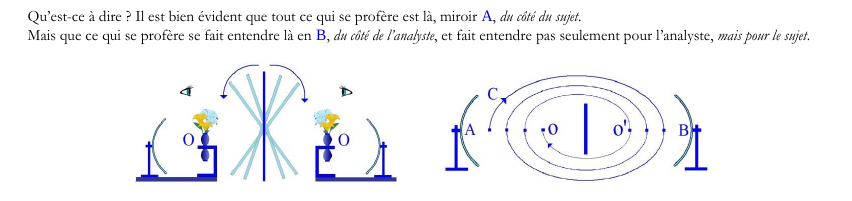
The optical scheme itself already includes the dimension of the real. If the optical scheme did not include the dimension…
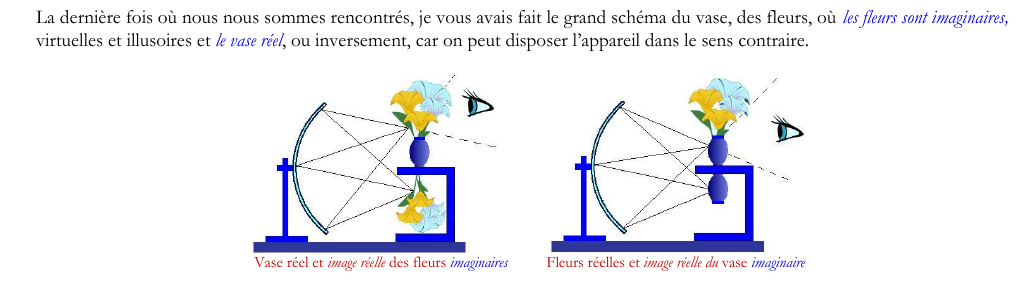
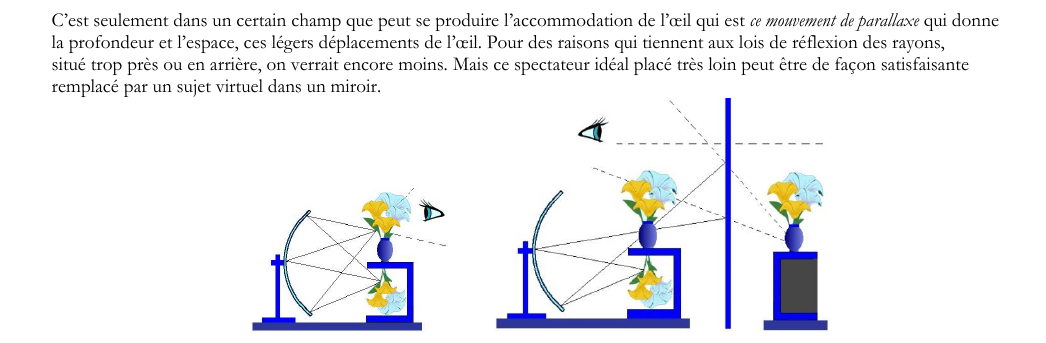
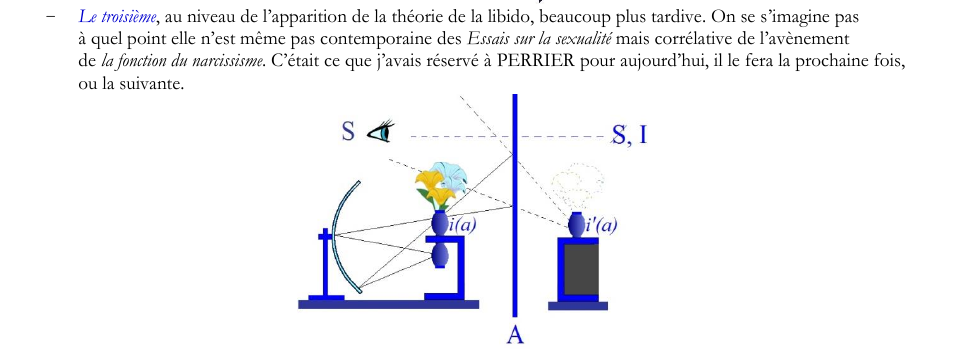
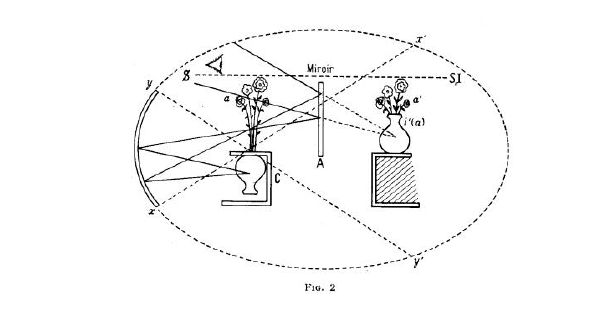
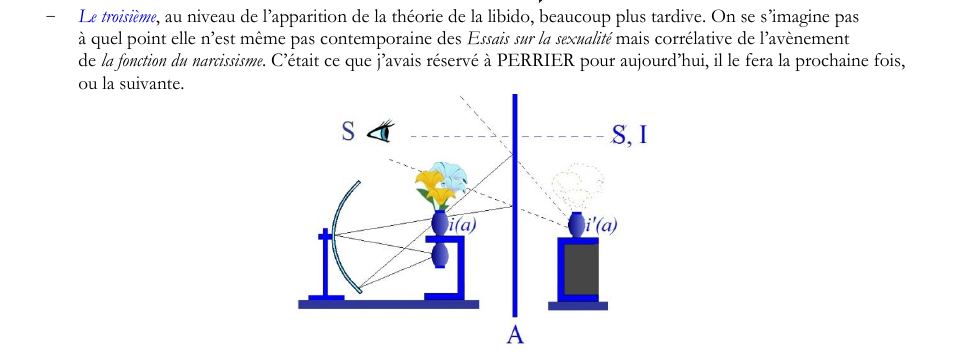
The optical scheme itself already includes the dimension of the real. If the optical scheme did not include the dimension of the Real, the optical scheme would be a scheme made with a single mirror, it would be Boasse’s scheme, because a mirror, a concave mirror, is enough to show us that the self is this illusion of totality that is evident in the recognition of oneself in the image projected in the mirror. If we look at the optical scheme: you must know the optical scheme, right? We have this first concave mirror, we have a box, a vase and the flowers underneath the vase, hidden, behind the box. The eye initially sees from here and it cannot see the flowers that are inside and underneath the box. Due to the reflections in this concave mirror, precisely It is something that we could relate to the Field of Language itself, due to the effect of this mirror, what is projected here is projected in an inverted way and in front of the mirror and produces the illusion of unity and this illusion of unity, this illusion of unity Lacan called the ideal self. ### This ideal self is already capable of showing us that the self is Imaginary, illusory, an illusion o…
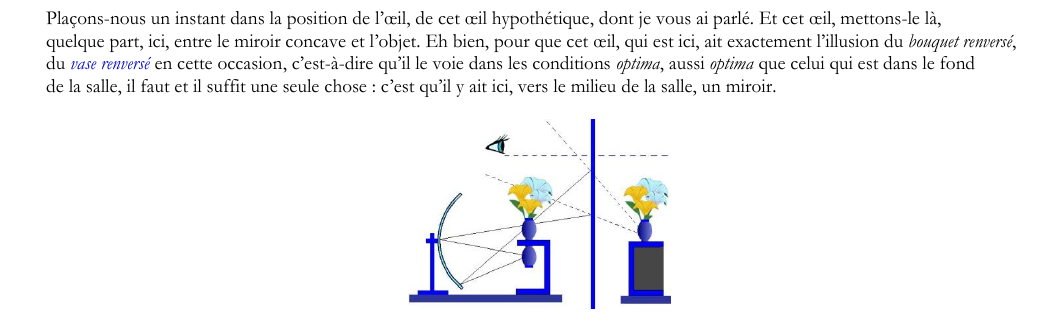
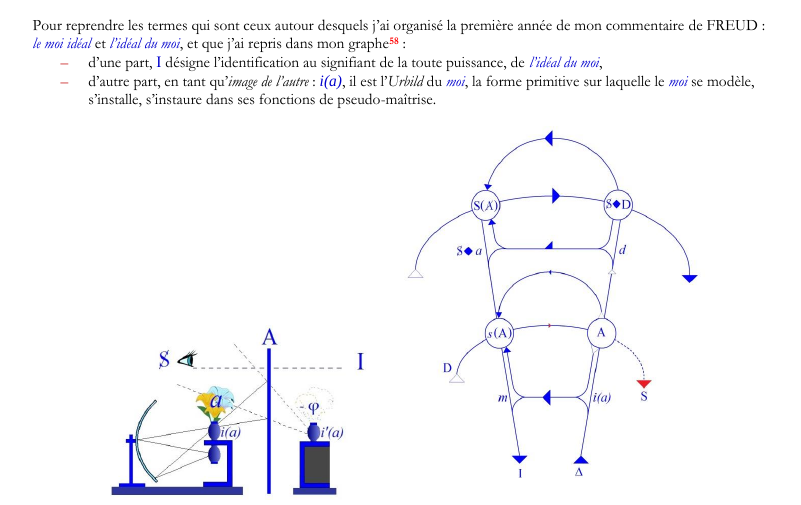
This ideal self isalready capable of showing us that the self is Imaginary, illusory, an illusion of totality and it is a source of alienation, which is what Lacan shows in these first seminars. This is already stated there. Notice, in principle we would not need a second mirror, why do we need a second mirror? Why did Lacan include a second mirror in the optical scheme? He placed this second mirror, the flat mirror and changed the place of the eye of the beholder, which he said is the place of the subject, to here, that is, the subject no longer sees what is placed as the ideal self, what does he see? The projection of this self from this second mirror. And then, curiously, these little flowers that are illusory here, they are also formed on the other side, by reflection of the flat mirror, in what is an unfolding that Lacan called the ego ideal.
And what is this scheme capable of showing us in seminar 1, because this optical scheme is already a…
And what is this scheme capable of showing us in seminar 1, because this optical scheme is already a scheme from seminar 1? It is capable of showing us that although this first mirror, this other one that says to the child: you are this, which is one of the metaphors that we found in this first mirror, although this is absolutely fundamental for the child to have an illusion of an ego, an image of itself, precisely, this ego is illusory, Lacan calls this, I don’t remember if in seminar 1 or in the text of the mirror stage, the unfinished urbild of the ego, that is, as soon as the child recognizes its mirror image, what does it do?
It turns to the person holding it in their lap to ask for confirmation that that image was its own. …
It turns to the person holding it in their lap to ask for confirmation that that image was its own. You see: there are two times: the first time is I am my self and if this were not an illusion, if something were not left out, there would be no turning of the head, that is, the turning of the head will be worked on by Lacan in seminar 10. In seminar 10, he returns to the optical scheme and why does he return to this scheme?
Because then he finally has a concept to talk about this turning of the head, he has a concept to ta…
Because then he finally has a concept to talk about this turning of the head, he has a concept to talk about that which is left out of the specularization. Thus, the identification is not with the image, but with the signifier, as the signifier cannot learn what we are in our totality, something is always left out and that which is left out is what requires the second mirror. This has already been subtly stated since seminar 1, since these first texts. It is very interesting to think about one thing: already in seminar 1, the way Lacan wrote the ideal Self is i(a).
This is also an incredible thing about Lacan’s teaching: the way he transmits concepts through lette…
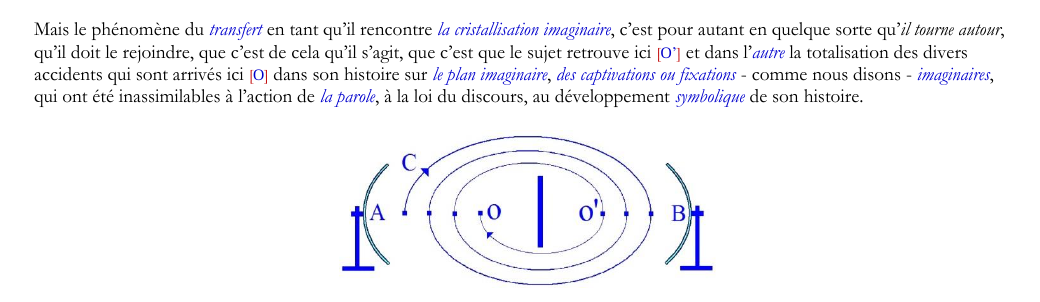
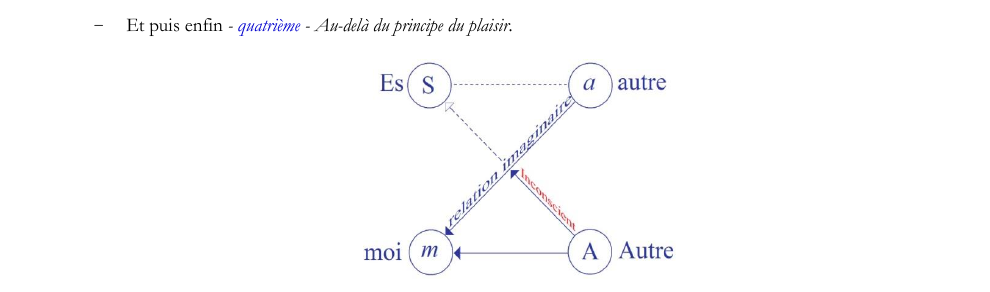
This is also an incredible thing about Lacan’s teaching: the way he transmits concepts through letters, mathemes, diagrams, and graphs allows him to revisit certain concepts in his work.nsmission of letter and then he will do a work, from the moment he has the object a as a concept, he can say of this image, that this image that tries in some way to locate this a which would be the position of the initial mythical subject in the optical scheme, for example. Here he will use a as this extension, this similar one that is in the L scheme, like the other one. The self and the other, one as an extension of the other, that’s why he uses the small a.