
Schema R
Fantasy, Ideals, Reality
Small Other
Big Other
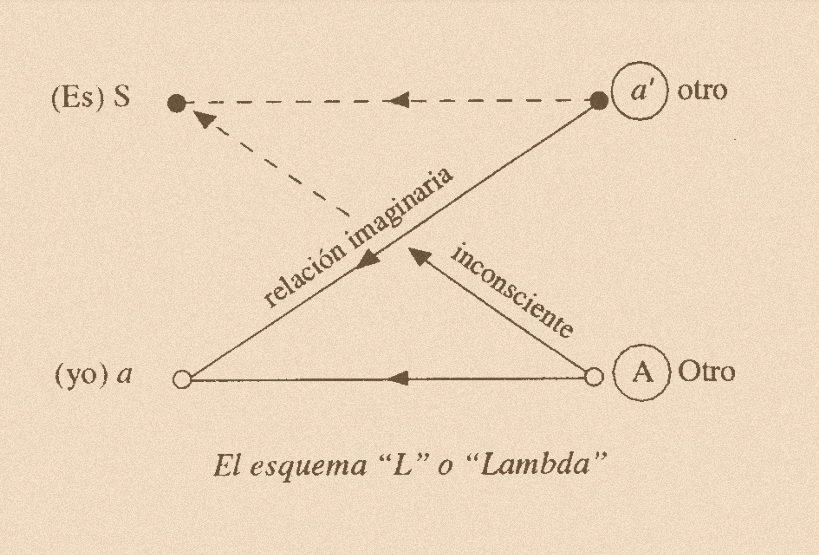
Scheme L is a model of speech structure. Speech starts with a subject who addresses another from the…
Scheme L is a model of speech structure. Speech starts with a subject who addresses another from the position of the self, the ego, and moves towards the Big Other. Then, from this place, which is the place of the Treasure, the signifier, the place of the unconscious, of the discourse of the unconscious, the message returns to the subject in an inverted manner, thus crossing this imaginary axis that resists meaning and dividing the subject from this return of its own message. - At the beginning we have an S and at the end we have a barred S.
Schema L
Basically, this Z is composed of two triangles, an Imaginary triangle on top and a symbolic triangle…
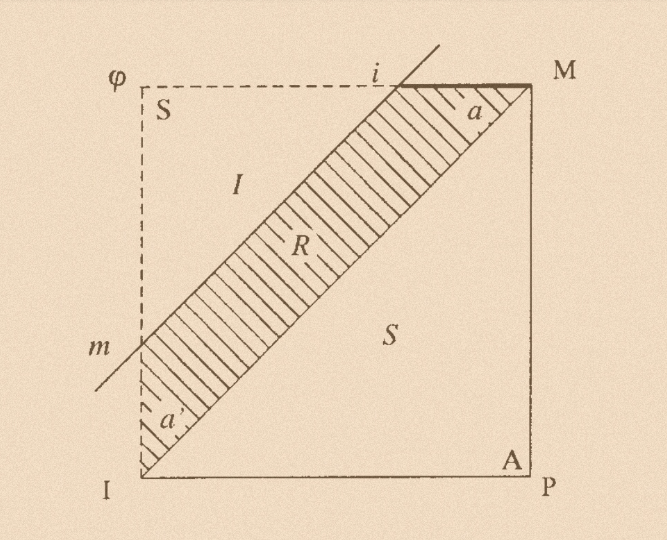
Basically, this Z is composed of two triangles, an Imaginary triangle on top and a symbolic triangle on the bottom. Between the two triangles we will have a stripe, this stripe represents precisely the reality that he wants to investigate. Reality as loss of reality, as castration, as fantasy that organizes the relationship of the subject, who is already at one end, with the other.
2 Triangles
He (Lacan) will incorporate what was deduced, what was formalized with the mirror stage, so it is co…
He (Lacan) will incorporate what was deduced, what was formalized with the mirror stage, so it is composed of two initial positions that are the relationship of the self, of the Imaginary self, with the image, an image that comes from the mirror. This will define for Lacan the retrospective appropriation of the self as the recognition of this image, as the symbolic realization of the reality of this image.
Imaginary Triangle
this therefore will occur in an extension of the self, in an extension that he writes in the R schem…
this therefore will occur in an extension of the self, in an extension that he writes in the R scheme as a’ so we have a moi, an a’ and we have the image that forms the self. It forms as a dualism, it forms as the self and its shadow, the self and its voice, the self and its consciousness, the self and its double.
a, a’, m, i
The first component aspect of reality in neurosis is this distance that exists between the ego and i…
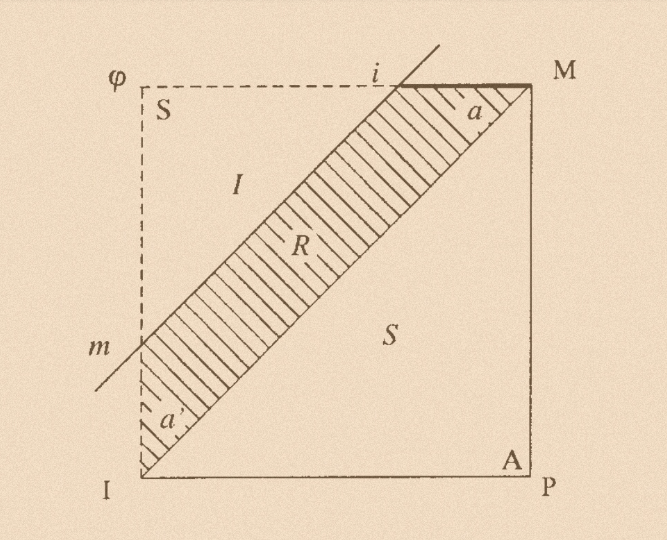
The first component aspect of reality in neurosis is this distance that exists between the ego and its double. This distance can be reduced or it can be expanded, depending on how this happens, we have effects on our feelings about ourselves: the ego grows, the ego diminishes, the ego becomes impoverished, the ego grows.
So we have the fourth element of the mirror stage, which is precisely the symbolic mother. It is the…
So we have the fourth element of the mirror stage, which is precisely the symbolic mother. It is the flat mirror that integrates the image of the ego, designating and returning this image according to the statement: You are this. The mother who holds the child in the formulation that we will find in observations on Daniel Lagache’s report, the mother who appears here as a capital M. So within this range we will actually have object a’, which is the double of the image in the image of the other and on the external part of this axis we will have the symbolic mother.
a, M
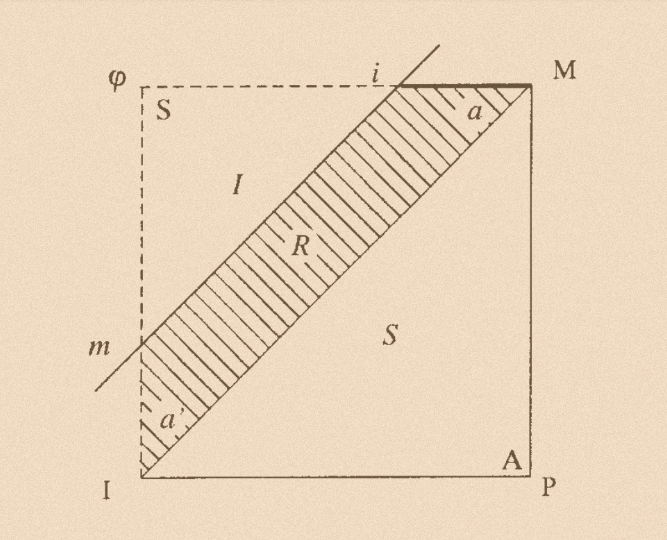
This first triangle formed by the moi, the ego, the image and a third element that will be the phall…
This first triangle formed by the moi, the ego, the image and a third element that will be the phallus, the phallus as the meaning of lack, the phallus as that which makes absence and presence, the phallus as that which answers questions about desire of the other, what the other wants, the other who wants the phallus, that’s why we identify with the phallus. Within which we have the experience of enjoyment.
Imaginary Triangle
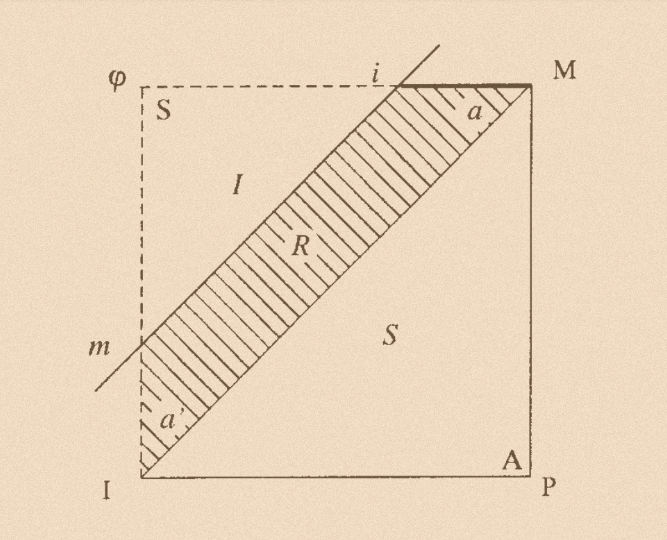
let’s remember that there in the mirror stage when the self recognized itself in an image, an effect…
let’s remember that there in the mirror stage when the self recognized itself in an image, an effect occurred which is one of satisfaction due to the integration of the image, when this integration does not occur we have an opposite effect which is one of aggressiveness, passion and aggression, hypnotic fascination and violence against others are two effects of the imaginary.
is composed of what would be the residual effect of the paternal metaphor. That which then establish…
is composed of what would be the residual effect of the paternal metaphor. That which then establishes the super ego on one side and the ego ideal on the other, the ego ideal is situated in this corner of the symbolic Triangle and it is a symbolic function, the ego ideal is ideal, it is not made to be realized. , it is a Horizon, it is where we are heading, it is a regulatory idea, it is what I should be, what I would like to be in order to satisfy the self in relation to the other. And if you observe within the intermediate range of the reality range, a’ will be located, what does this a’ represent? It represents the superego, it represents this obscene object, it represents this object that asks for more and more pleasure, this object that would be like this, that orders pleasure but also prohibits satisfaction.
Symbolic Triangle
I, a’
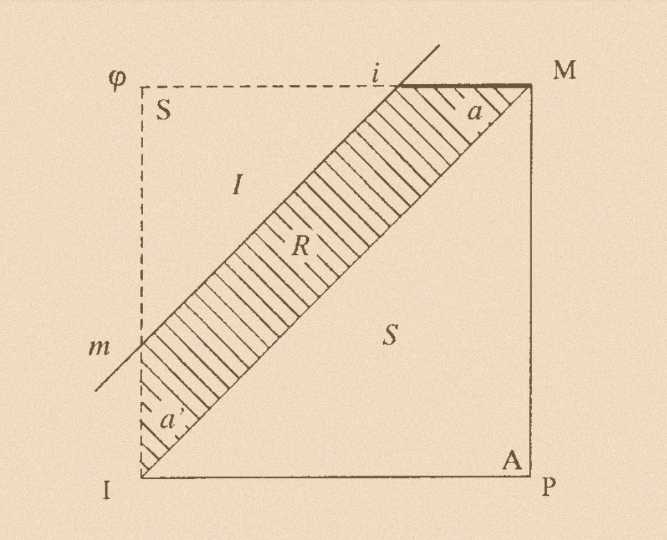
symbolic mother who is the one who interprets her child, who hears in the crying this is hunger this…
symbolic mother who is the one who interprets her child, who hears in the crying this is hunger this is thirst this is pain, this is tantrum, the symbolic mother is the one who alternates presence and absence, the one who introduces the object of Gift to the child, who It allows the child to realize that their act of donating is more important because it signifies love than the object itself that is being donated in this operation.
Symbolic Mother
Field of the Other which is the inverse equivalent of the field of enjoyment. - It has a hole, it is…
Field of the Other which is the inverse equivalent of the field of enjoyment. - It has a hole, it is not a homogeneous field, and it is not a complete field. - Inscribes its own incompleteness, Non-totality. - That makes a hole. - Where the father’s name will pinch the phallus that is on the other side and insert it into this symbolic hole.
Father’s-Name
substitution operation and replaces the child’s relationship with the mother with the mother’s relat…
substitution operation and replaces the child’s relationship with the mother with the mother’s relationship with the father. - To be, to have, the phallus, the gift. - Mother’s wish.
Fatherly Metaphor
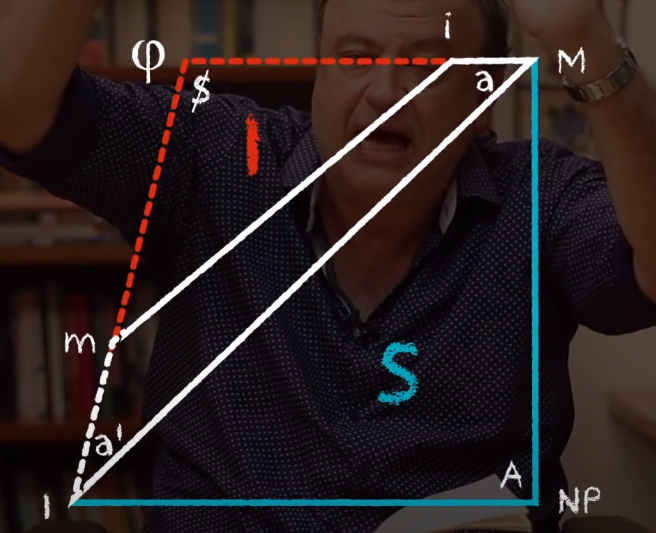
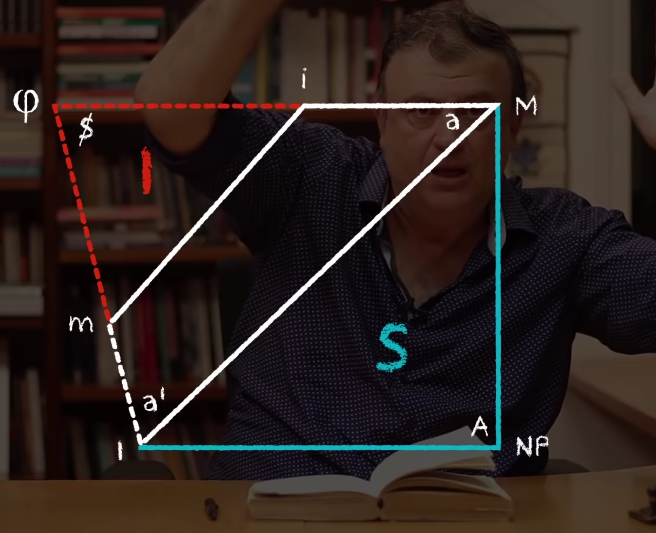
We form here in the center of this quadrilateral a strip, a band, a band formed by moi, a’, a and i…
We form here in the center of this quadrilateral a strip, a band, a band formed by moi, a’, a and i. This band will assume a twisting property in such a way thatand the i will connect with a’ and the m will connect with a forming a Moebius band.
Reality Strip
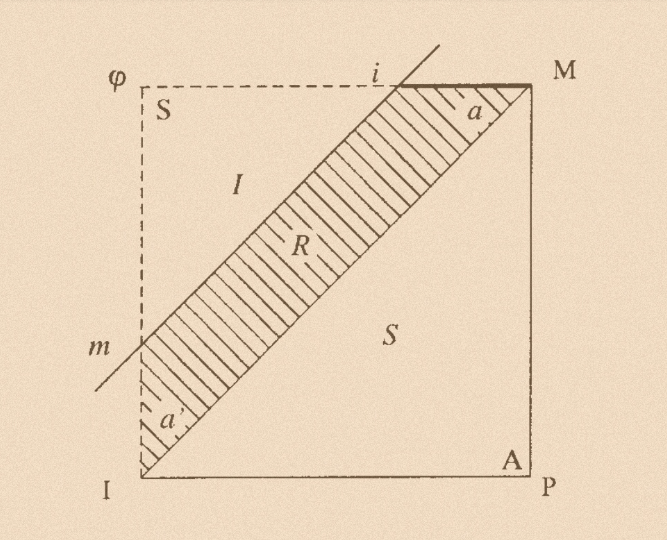
Phallus, mirror image, Symbolic Mother. - Every identification corresponds to a choice of complement…
Phallus, mirror image, Symbolic Mother. - Every identification corresponds to a choice of complementary object and the Oedipus complex is a conflict between identification and object choices. - Identification with phallus, identification with image, identification with object and identification with mother or with the other.
Identification Series
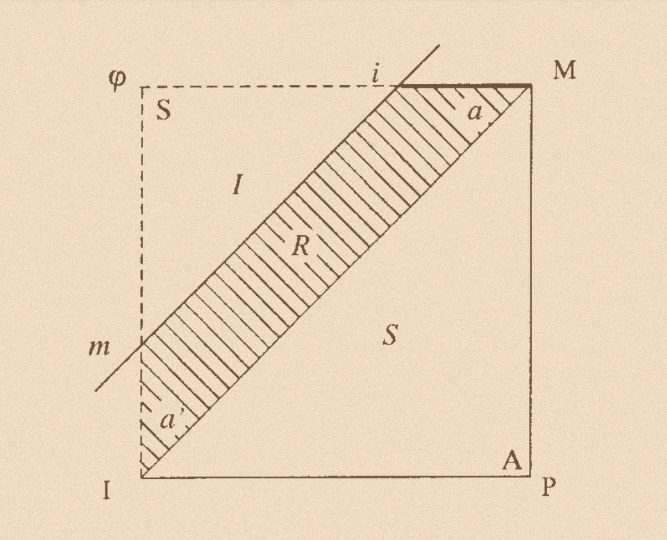
Name-of-the-Father and Ideal of Self.
Object choice series
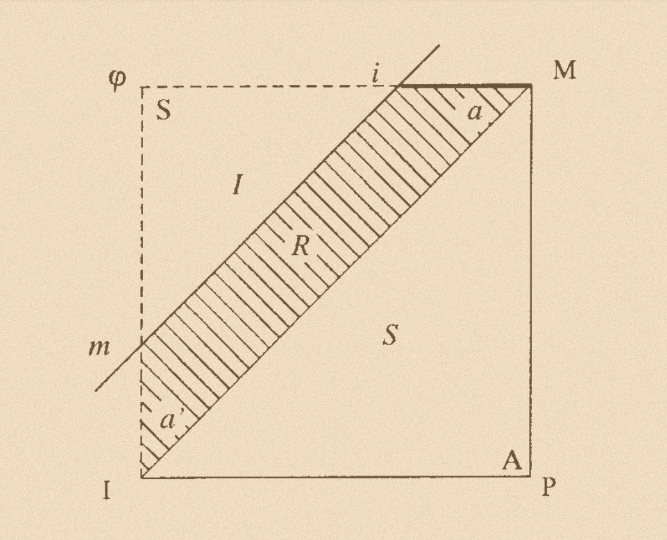
Ghost Series
Composed of the phallus, the position of moi, the position of a’ and the I(a) or ideal of self. Impo…
Composed of the phallus, the position of moi, the position of a’ and the I(a) or ideal of self. Important elements for listening to the subject’s fantasy. Fantasy has this function of associating the phallus with the self, the self with the object and the object with the ideal.
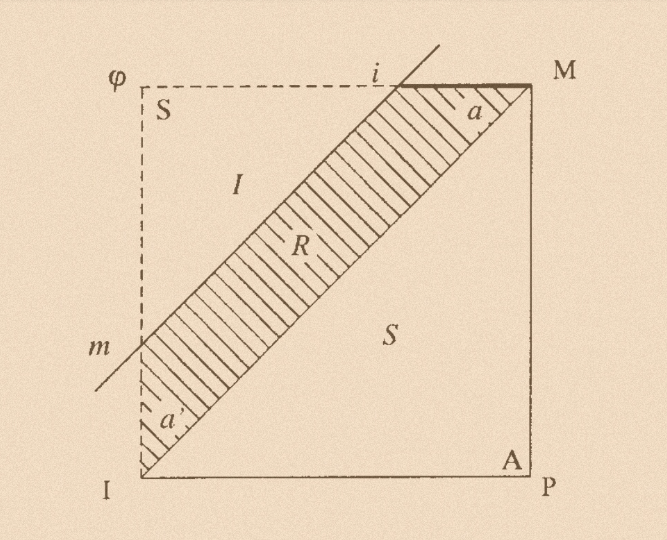
When any of these points become misaligned, we experience a shock to the ghost. It can also be seen …
When any of these points become misaligned, we experience a shock to the ghost. It can also be seen that the series of identifications also alters the axis of the ghost, which has to adapt to this series. These are the manipulations within the Imaginary that are responsible for the economy of enjoyment, the neurotic calculation of enjoyment.
Changes in the axes
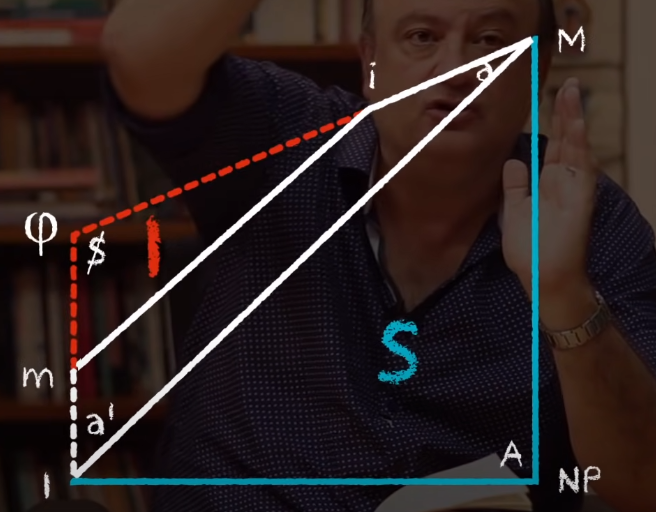
The R scheme is made by joining two triangles, symbolic ternary and imaginary ternary, by the real q…
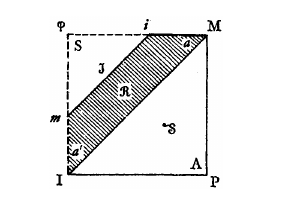
The R scheme is made by joining two triangles, symbolic ternary and imaginary ternary, by the real quadrilateral, delimited in a square at the base of each one. If the symbolic triangle alone occupies half of the square, the other two figures divide the second between themselves - this is because, when structuring them, it has to encompass them in the drawing. As for the dotted line, it is placed in the imaginary. This construction requires a double reading: 1. It can be read as a representation of the subject’s static; in it, the following are distinguished: (a) the triangle J, which rests on the dual relationship between the Self and the Other (narcissism, pro(jection, capture), having as its apex ç, the phallus, an imaginary object “in which the subject identifies himself (…) with his being as a living being”, that is, the appearance under which the subject represents himself;
(b) the field S, with the three functions: of the Ideal of the Ego, I, through which the subject sit…
(b) the field S, with the three functions: of the Ideal of the Ego, I, through which the subject situates himself in the register of the symbolic; of the signifier of the object, M, and of the Name-of-the-Father, P, in place of the Other, A. We can consider that the line I M reproduces the relationship of the subject with the object of desire through the signifying chain, a relationship that Lacanian algebra would later note as S*a (but the line soon reveals itself to be an inadequate representation); (c) the field R, framed and maintained by the imaginary relationship and the symbolic relationship. 2. But there is also the history of the subject, whose notation is: in the segment i M the figures of the imaginary other are placed, culminating in the figure of the mother, the real Other, inscribed in the symbolic under the signifier of the primordial object, the first exterior of the subject, which in Freud is called das Ding; in the segment m I the imaginary identifications forming the child’s Ego succeed each other until it receives its status in the real, through symbolic identification.
A specific synchrony of the S theme is thus discovered: the child in I connects with the mother in M…
A specific synchrony of the S theme is thus discovered: the child in I connects with the mother in M, as the desire of his desire; in the third position is the Father, conveyed by the mother’s speech. Lacan shows, in his 1966 note, how to translate this square into his topology. The surface R should be taken as the flattening, placement on a plane of the figure that would be obtained by joining i to I and m to M, therefore, by the torsion that characterizes the Moebius strip in the complete space: the presentation of the scheme in two dimensions, therefore, must be referred to the cut that extends the strip. It is thus understood that the line I M cannot refer to the relationship of the subject with the object of desire: the subject is only the cut of the strip, and what falls from there is called object a, which confirms and completes Jean-Claude Milner’s formula on “$*a”: the terms are heterogeneous, while there is a homogeneity linked to the places”. This is the power of the symbol.